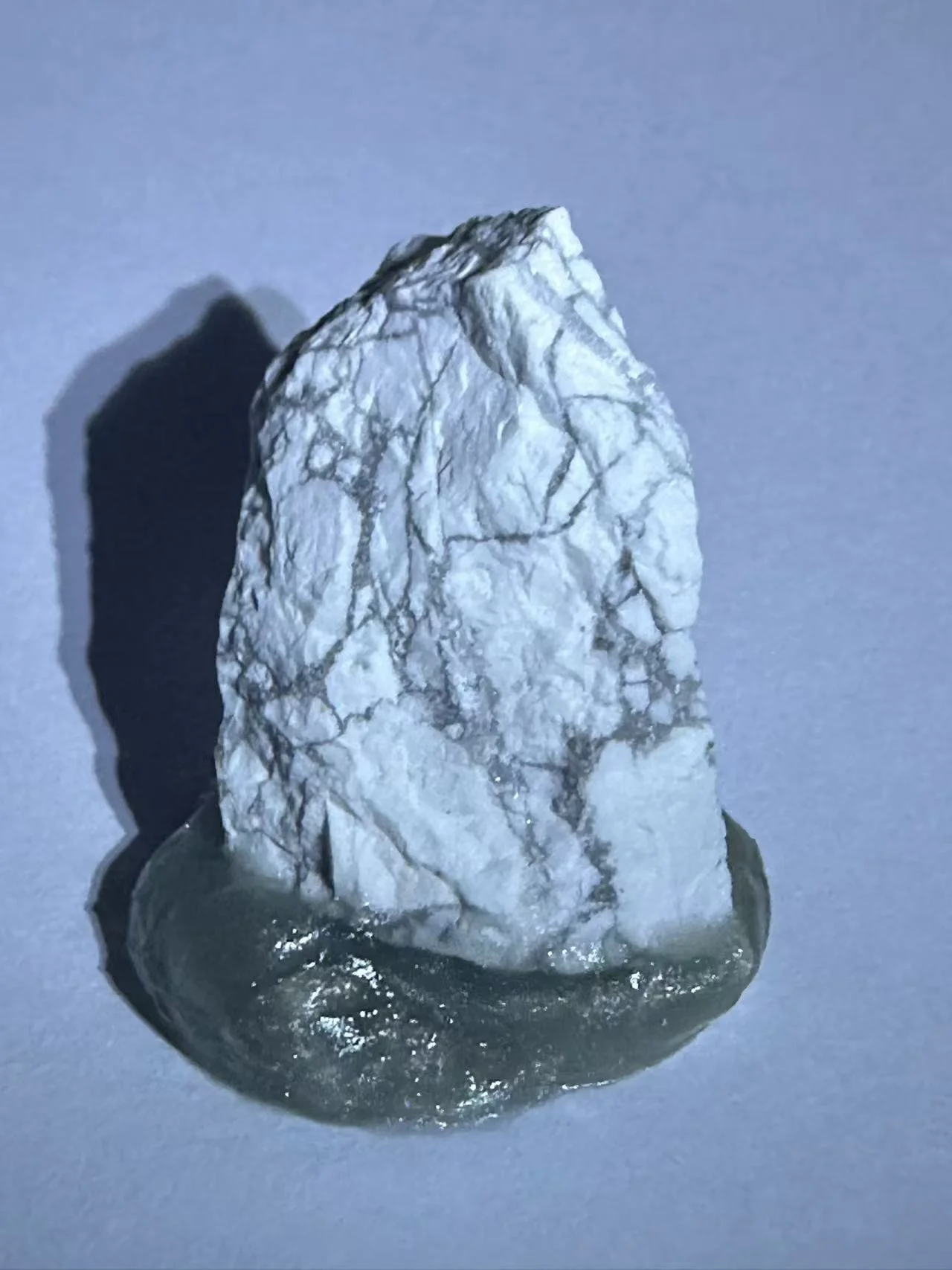
White Howlite
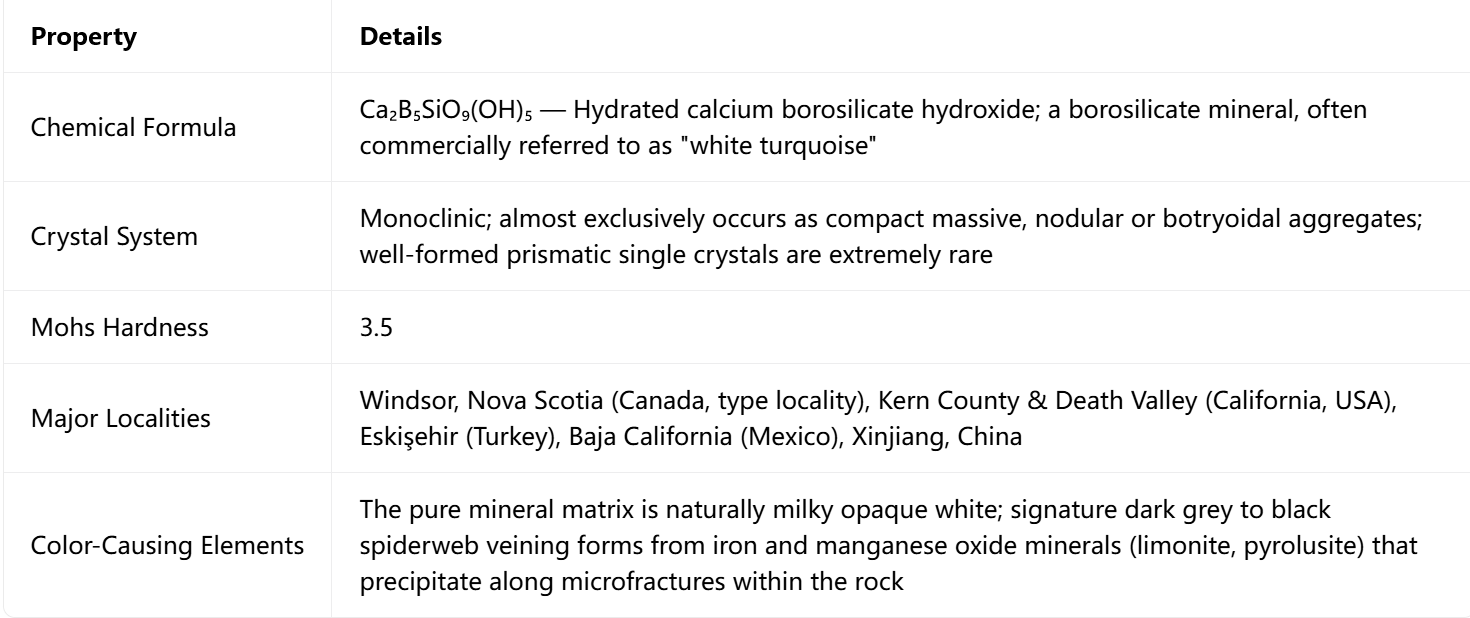
Basic Properties of White Howlite
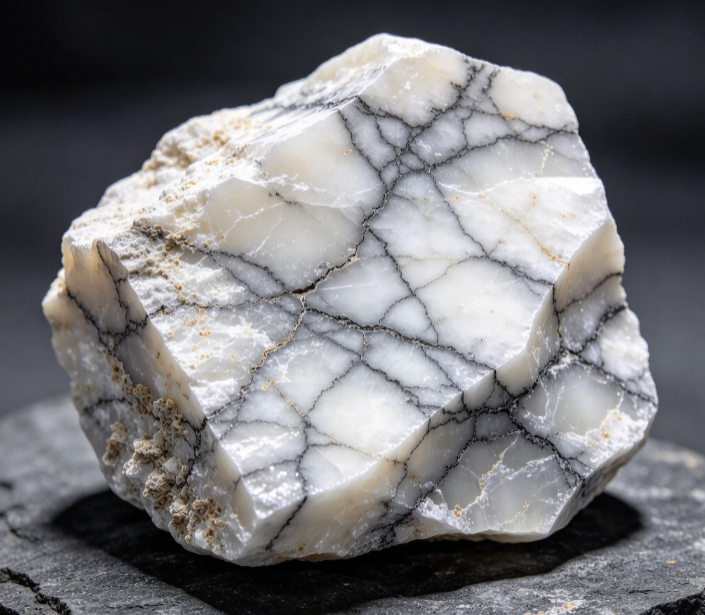
Mineral Characteristics
Howlite is a distinct hydrated calcium borosilicate mineral first formally described in 1868 by Canadian mineralogist Henry How, for whom the species is named. It crystallizes in the monoclinic system, but euhedral, individually distinguishable crystals are exceptionally uncommon in nature. Nearly all commercial and collector material occurs as dense, fine-grained massive aggregates, typically exhibiting botryoidal, reniform or cauliflower-like nodular external surfaces. Fresh fracture surfaces display a dull vitreous to earthy luster, while polished faces develop a smooth, waxy sheen. The mineral shows one direction of imperfect cleavage and a characteristic conchoidal fracture, producing rounded, shell-like breakage edges.
Gem-quality howlite forms primarily in borate-bearing evaporite sedimentary basins, where it crystallizes from boron-rich hypersaline brines in close association with gypsum, anhydrite, calcite, borax and ulexite. It may also occur as a secondary alteration phase in low-temperature hydrothermal vein systems. The uniform milky white body color is an intrinsic property of the pure calcium borosilicate crystal lattice. The iconic dark reticulated veining that defines commercial howlite is not a primary growth feature, but a supergene alteration product: post-depositional meteoric fluids carrying dissolved ferric iron and manganese oxides percolate along microcracks and grain boundaries, depositing dark oxide minerals within the fracture network. The fineness, density and regularity of this veining are the primary factors grading the aesthetic quality of the material.
Gemological & Industrial Applications
In the global gem and jewelry industry, howlite is a popular versatile ornamental stone prized for its crisp white base, graphic contrasting veining and exceptional carvability. Its relatively low hardness and uniform, fine-grained texture make it easy to cut, shape and polish. It is most commonly fabricated into polished cabochons, round beads for bracelets and necklaces, pendants, earrings, and larger decorative carvings and ornamental objects. Due to its Mohs hardness of only 3.5 and vulnerability to scratching and impact damage, it is not recommended for daily-wear ring settings, and performs best in protected jewelry pieces and display items. A widespread commercial application is dyeing howlite shades of blue and green to imitate turquoise; its natural porosity allows dye to penetrate evenly, creating a convincing visual substitute for the far rarer and more expensive gem at a fraction of the cost. In recent years, undyed natural white howlite has also grown in popularity for minimalist and contemporary jewelry designs.
Industrially, howlite is of secondary economic importance relative to major industrial borate minerals such as borax and kernite. Low-grade massive howlite associated with commercial borate deposits is occasionally processed as a supplementary boron feedstock for specialty ceramics, high-temperature glass compositions and enamel glazes. The overwhelming majority of its economic value, however, derives from lapidary, decorative and collector markets. Well-preserved nodular specimens with strong black-and-white contrast and intact botryoidal surfaces are highly valued by mineral collectors.
Cultural Significance
The mineral’s name pays tribute to its discoverer, Henry How, marking its place in 19th-century North American mineralogical discovery. Though it lacks the ancient historical lore of older gemstones, howlite has developed rich symbolic meaning in contemporary wellness and crystal culture.
Widely known as the “Stone of Calm” in modern metaphysical traditions, howlite is strongly associated with tranquility, emotional balance and stress relief. It is commonly used in meditation and sleep practices, where it is believed to quiet racing thoughts, release pent-up tension and soothe feelings of anger, anxiety and overwhelm. Its clean white base is symbolically linked to purity, clarity and fresh starts, while the interwoven dark veins are interpreted as a metaphor for integrating difficult experiences into wholeness and growth.
Within popular culture, howlite is also widely recognized as the most common natural imitation of turquoise, serving as an accessible entry point for colored stone jewelry. In the mineral collecting community, fine specimens from the classic Nova Scotia type locality remain prized cabinet pieces, celebrated for their distinctive morphology and striking graphic contrast.