Obsidian
Basic Properties of Obsidian

Mineral Characteristics
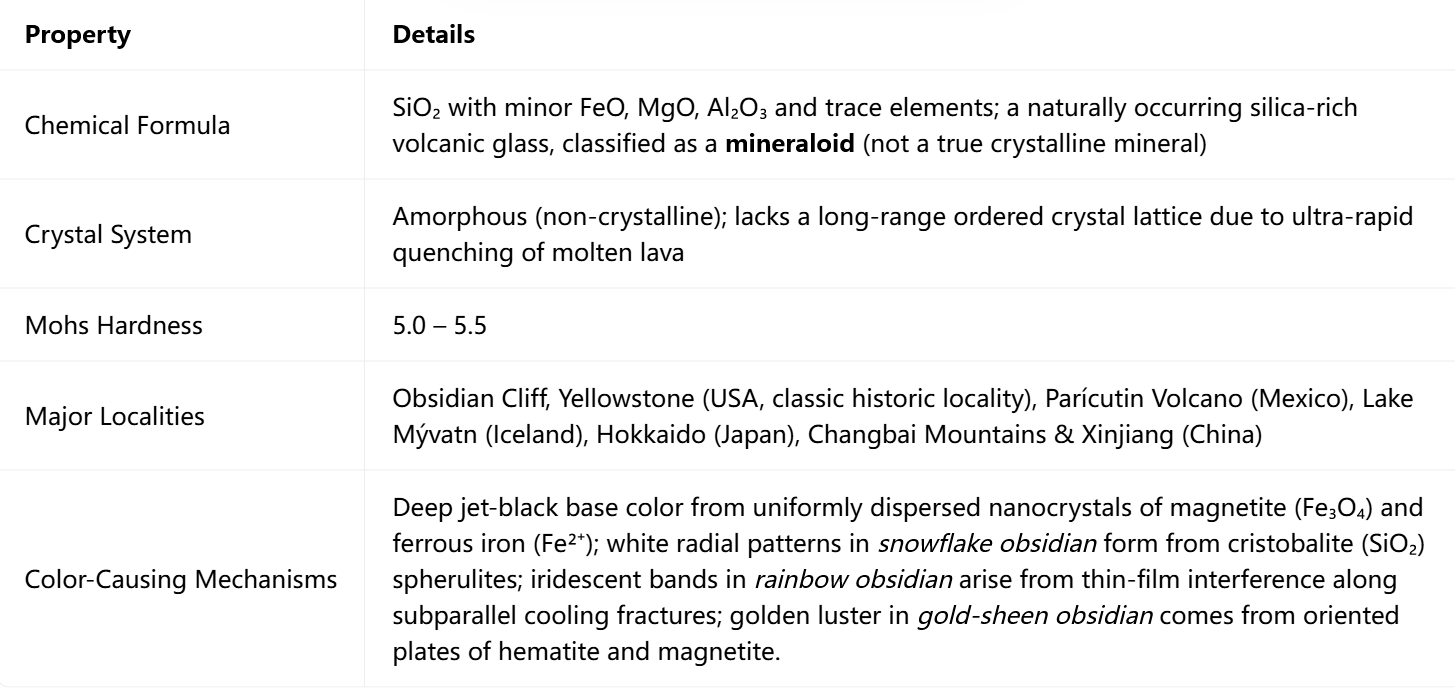
Obsidian is a naturally occurring volcanic glass and formally categorized as a mineraloid rather than a true mineral, as it possesses no regular crystalline lattice structure. It forms when silica-rich felsic lava extruded from volcanic vents cools extremely rapidly (quenches) at or near the Earth’s surface, leaving insufficient time for crystal nucleation and growth. The result is a homogeneous, isotropic glass with a smooth, uniform texture and brilliant vitreous luster on fresh surfaces. Its most diagnostic physical feature is a pronounced conchoidal fracture, which produces sharp, curved breakage surfaces with shell-like ripples — a property that has defined its human use for millennia.
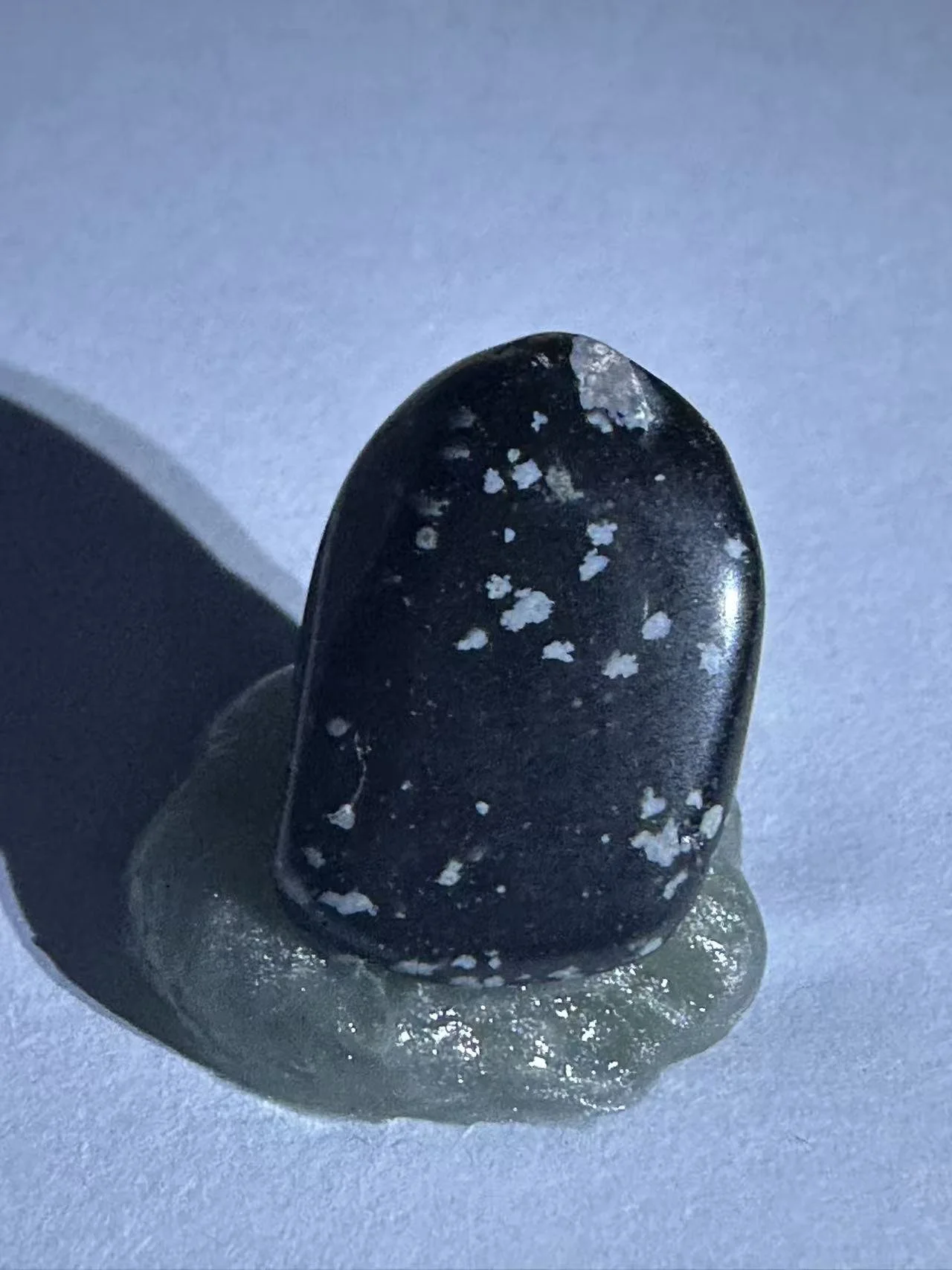
Natural obsidian ranges from opaque jet-black to translucent dark brown in thin edges. Several distinct ornamental varieties are recognized based on internal textures and inclusions. Snowflake obsidian contains evenly distributed white, radially symmetrical cristobalite spherulites that form during late-stage devitrification of the glass. Rainbow obsidian displays delicate, iridescent bands of blue, green, gold and violet, created when light reflects off closely spaced, subparallel cooling fractures within the rock. Gold-sheen obsidian carries oriented micro-plates of hematite and magnetite that produce a warm, rolling metallic glow when tilted. Mahogany obsidian features reddish-brown streaks and patches of oxidized iron oxides. Gem-quality obsidian occurs most commonly in the upper chilled margins of rhyolitic lava flows and volcanic domes, and is often recovered as angular blocks from secondary talus and alluvial deposits.
Gemological & Industrial Applications
In the global gem and jewelry trade, obsidian is a widely popular ornamental material valued for its deep uniform black color, high polishability and accessible price point. It is most commonly fashioned into polished cabochons, round beads for bracelets and necklaces, pendants, earrings, and larger decorative carvings and figurines. Snowflake obsidian is a staple of artisanal and casual jewelry, while high-grade rainbow obsidian with sharp, vivid iridescence commands premium prices among collectors. With a Mohs hardness of 5.0–5.5 and inherent brittleness, it is best suited for protected jewelry pieces and display items rather than daily-wear ring settings.
Historically, obsidian was one of the most technologically critical materials in human prehistory. Its conchoidal fracture produces edges sharper than high-carbon steel at the microscopic scale, making it the premier material for projectile points, blades, scrapers and cutting tools for tens of thousands of years. In modern industry, high-purity obsidian is occasionally fabricated into specialty surgical scalpel blades for precision ophthalmic and microsurgery, as its edge can achieve a smoothness unmatched by conventional steel instruments. Low-grade bulk obsidian is also used as a decorative dimension stone for landscape architecture and interior cladding, and as a raw material for specialty glass-ceramic composites and refractory materials.
Cultural Significance
The name obsidian derives from the Latin obsidianus lapis (“stone of Obsius”), named by the Roman naturalist Pliny the Elder after a legendary Ethiopian explorer who was said to have first discovered similar black glass in North Africa. Across nearly every ancient civilization with access to volcanic terrain, obsidian held profound ritual, practical and symbolic importance.
In Mesoamerica, the Aztec and Maya civilizations crafted obsidian into sacrificial blades, ceremonial mirrors and ritual ornaments, believing it embodied the power of the underworld and could reveal hidden truths and visions. Ancient Egyptians carved it into amulets, eye inlays for divine statues and funerary objects, associating it with protection and eternal life. The Māori people of New Zealand revered obsidian — called matā — as a sacred taonga (treasure), fashioning it into precision cutting tools and ceremonial objects.
In contemporary metaphysical and crystal healing traditions, obsidian is universally known as the “Stone of Protection” and a primary stone for grounding and purification. It is believed to absorb stagnant and negative energy, shield against emotional harm, release deep-seated psychological blockages, and support shadow work and self-reflection. Black obsidian is most commonly linked to the root chakra, while rainbow obsidian is associated with emotional healing and spiritual integration. Archaeologically, obsidian is also an irreplaceable tracer material: its unique geochemical fingerprint allows precise sourcing to its volcanic origin, enabling researchers to reconstruct ancient trade networks spanning thousands of kilometers and tens of thousands of years.