What is Biomineralization?
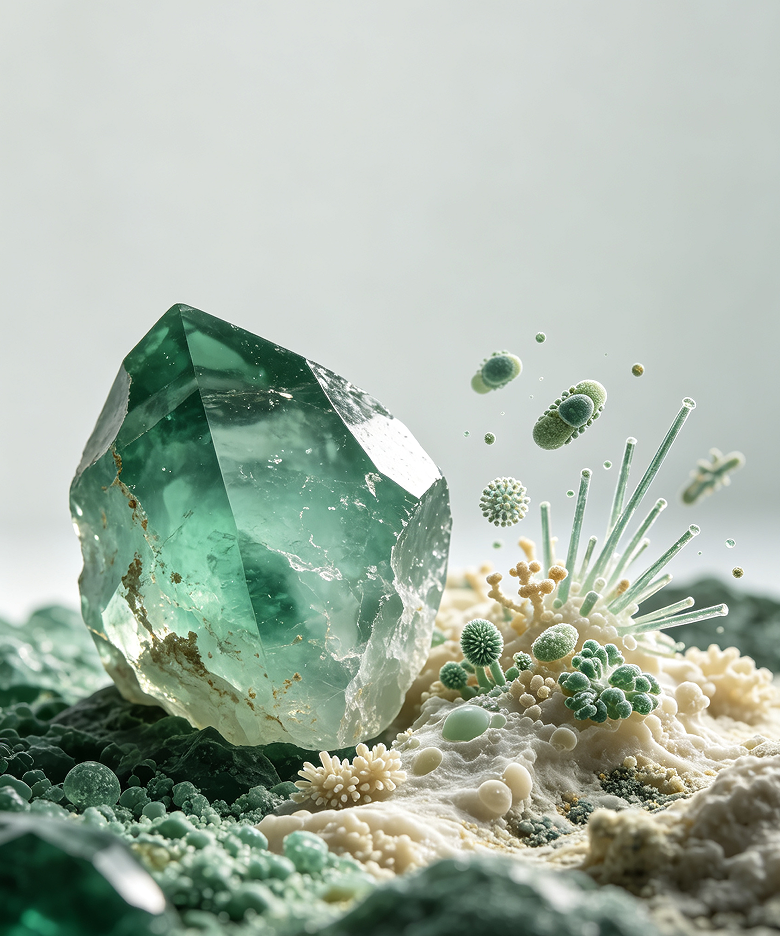
Biomineralization is the process by which living organisms regulate or induce the formation of minerals. Standing at the core intersection of biology and geology, it links cellular life activity to planetary geochemical cycles, shaping rocks, sediments, and ecosystems over geological time.
There are two primary modes of biomineralization:
Biologically Controlled Mineralization
In this mode, organisms tightly regulate the chemical composition, crystal structure, and external morphology of the minerals they form. Mineral growth is guided by specialized cellular mechanisms and organic templates, producing highly ordered, species-specific structures. Common examples include mollusk shells, vertebrate bones and teeth, and the silica frustules of diatoms.
Biologically Induced Mineralization
This mode occurs when microbial metabolic activity modifies local environmental conditions—including pH, redox potential, and dissolved ion concentrations—triggering the spontaneous precipitation of minerals from surrounding solutions. This process is the fundamental principle behind microbial environmental remediation, as it can convert soluble, mobile contaminants into stable, insoluble mineral phases.
A hallmark of biominerals is their hierarchical, ordered structure across multiple length scales. This biological precision often gives biominerals distinctive and superior physical properties, such as enhanced strength and toughness, that frequently outperform artificially synthesized minerals.