Schorl
Basic Properties of Schorl
Mineral Characteristics
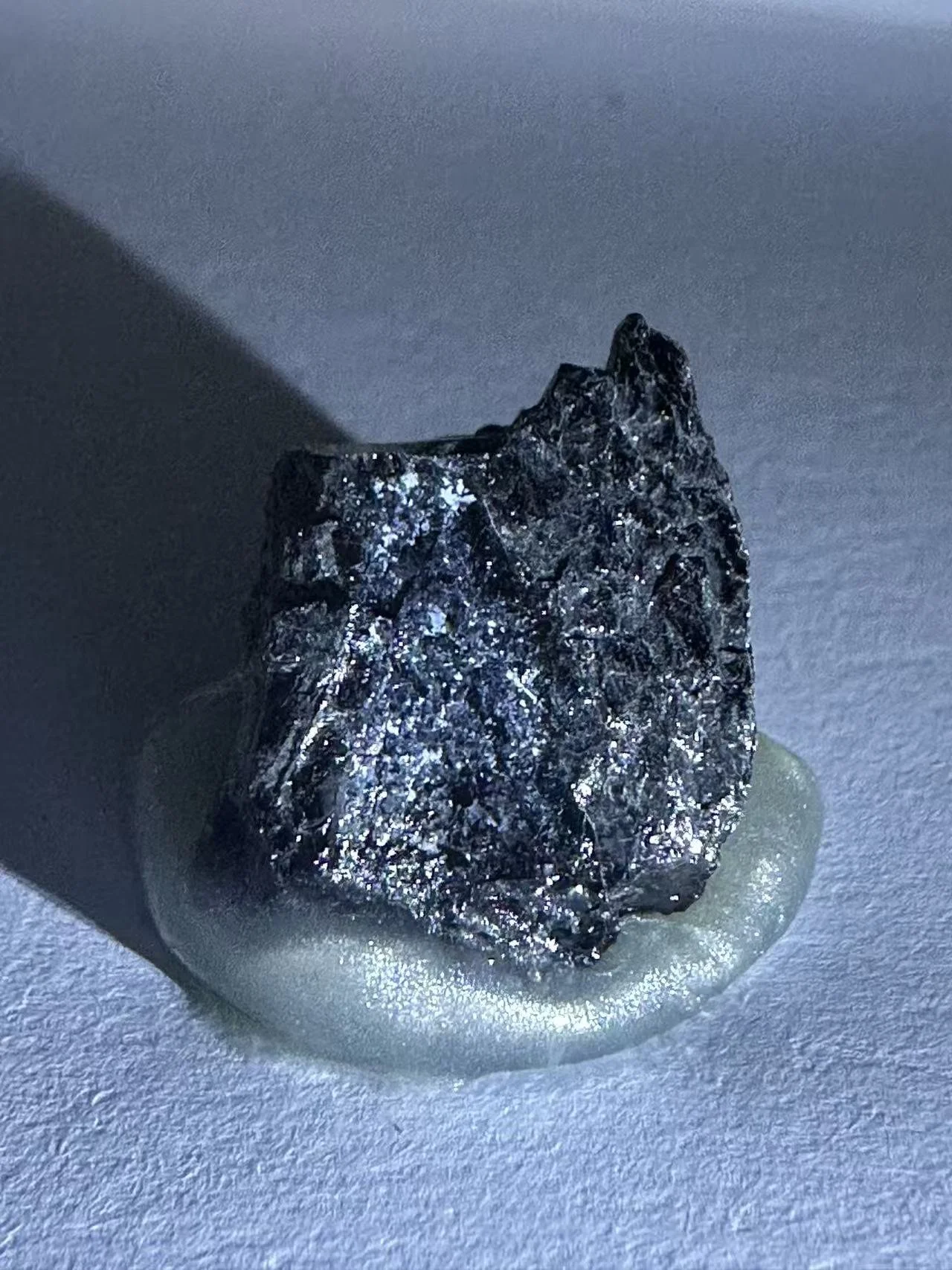
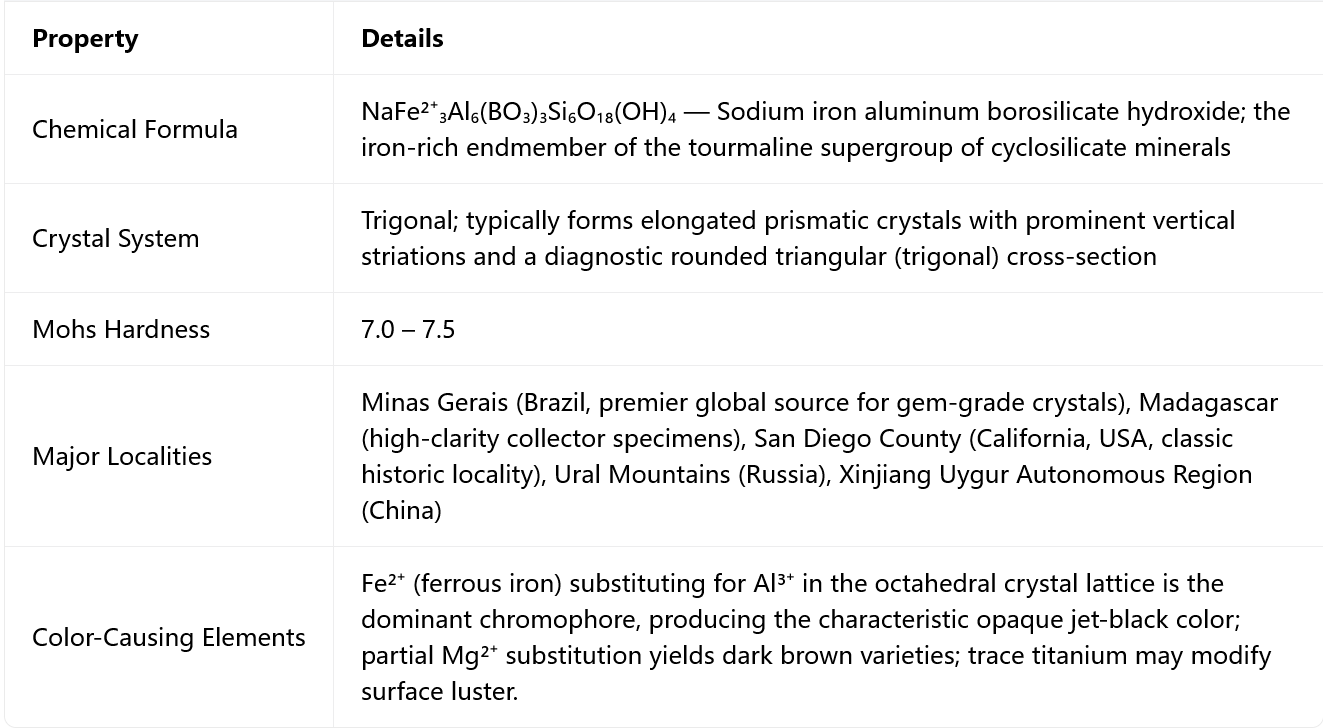
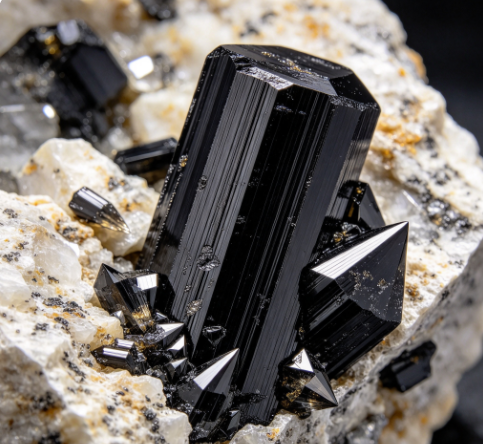
Schorl, commonly known as black tourmaline, is the most abundant and widely distributed endmember species of the tourmaline supergroup, a structurally complex family of ring silicates defined by their six-membered silica tetrahedral rings and boron-bearing crystal framework. It crystallizes in the trigonal system, most commonly developing long, slender prismatic crystal habits marked by deep parallel longitudinal striations along the c-axis. The most diagnostic morphological feature is its characteristic trigonal cross-section — a rounded three-sided outline that distinguishes tourmaline crystals from all other prismatic mineral species. Crystals often terminate in complex pyramidal faces, and occur both as individual free-standing crystals and as radiating fibrous or columnar aggregates. Fresh surfaces display a vitreous to slightly resinous luster, and the mineral exhibits no true cleavage, breaking with a conchoidal to uneven fracture.
Gem-quality schorl forms primarily in granitic pegmatites, high-temperature hydrothermal vein systems and contact metamorphic aureoles, where it crystallizes from boron-rich fluids in open cavities in association with quartz, feldspar, muscovite, beryl and spodumene. It is also a common accessory mineral in regional metamorphic rocks and granitic intrusions. The characteristic deep black coloration arises from intervalence charge transfer between ferrous and ferric iron ions within the octahedral coordination sites of the crystal lattice, resulting in near-total absorption across the visible spectrum. Most schorl is opaque, though high-purity, iron-poor specimens may be translucent in thin edges.
Physically, schorl is distinguished by two remarkable electrical properties: piezoelectricity, the generation of an electrical charge across the crystal when subjected to mechanical stress, and pyroelectricity, the generation of charge in response to temperature changes. These effects arise from the mineral’s asymmetric polar crystal structure, and make tourmaline one of the most technologically important mineral groups.
Gemological & Industrial Applications
In the global gem and jewelry industry, schorl is the most commercially widespread variety of tourmaline, valued for its deep uniform black color, excellent durability and approachable price point. It is most commonly fashioned into round beads for bracelets and necklaces, polished cabochons for pendants, rings and earrings, and larger ornamental carvings and figurines. A rare chatoyant variety known as cat’s eye schorl commands a premium, and is always cut en cabochon to display its sharp, silky light band. With a Mohs hardness of 7.0–7.5 and good toughness, black tourmaline is highly scratch-resistant and suitable for all types of jewelry including daily-wear pieces. Its neutral, versatile black tone has made it increasingly popular in contemporary unisex and minimalist jewelry designs.
Industrially, schorl and other tourmaline species are valued for their unique piezoelectric and pyroelectric properties. They are manufactured into precision pressure sensors, hydrophone elements, frequency control devices and ultrasonic transducers for applications in aerospace, defense, medical imaging and industrial metrology. Finely milled tourmaline powder is also incorporated into functional materials: it is used in negative-ion generating products, water treatment filtration media and antimicrobial coatings, leveraging the mineral’s permanent electrostatic polarity to adsorb contaminants and modify water structure. Lower-grade massive tourmaline rock is also used as a high-hardness abrasive medium and as a raw material in specialty technical ceramics and refractory materials.
Cultural Significance
The name schorl derives from the historic mining town of Schorl in Saxony, Germany, where the mineral was first systematically described and mined in the early modern era. The broader name tourmaline comes from the Sinhalese word thoramalli, meaning “stone with mixed colors”, a reference to the multicolored tourmaline crystals first traded through Sri Lanka.
Throughout history, black tourmaline has been revered across cultures as a protective stone. Ancient mariners and travelers carried schorl talismans to ward off danger and ensure safe passage, while medieval European folklore held that the stone could repel negative energies and evil spirits. Indigenous cultures across the Americas and Africa used black tourmaline in purification rituals and healing ceremonies, valuing its perceived ability to ground and center spiritual energy. The mineral’s curious property of attracting lightweight particles when heated — a result of its pyroelectric effect — was noted as early as the 18th century, earning it the nickname “the Ceylon magnet”.
In contemporary metaphysical and crystal healing traditions, black tourmaline is universally regarded as one of the primary stones of protection and grounding. It is strongly associated with the root chakra, and is believed to absorb and transmute stagnant or negative energy, shield against emotional toxicity and environmental stress, and provide a sense of stability and security. It is one of the most commonly recommended stones for workplace and home placement, where it is thought to neutralize electromagnetic radiation and promote a calm, focused environment. Within the mineral collecting community, fine euhedral schorl crystals from classic pegmatite localities remain highly prized cabinet specimens, celebrated for their striking form, perfect striations and iconic jet-black luster.