Apatite
Basic Properties of Apatite
Mineral Characteristics
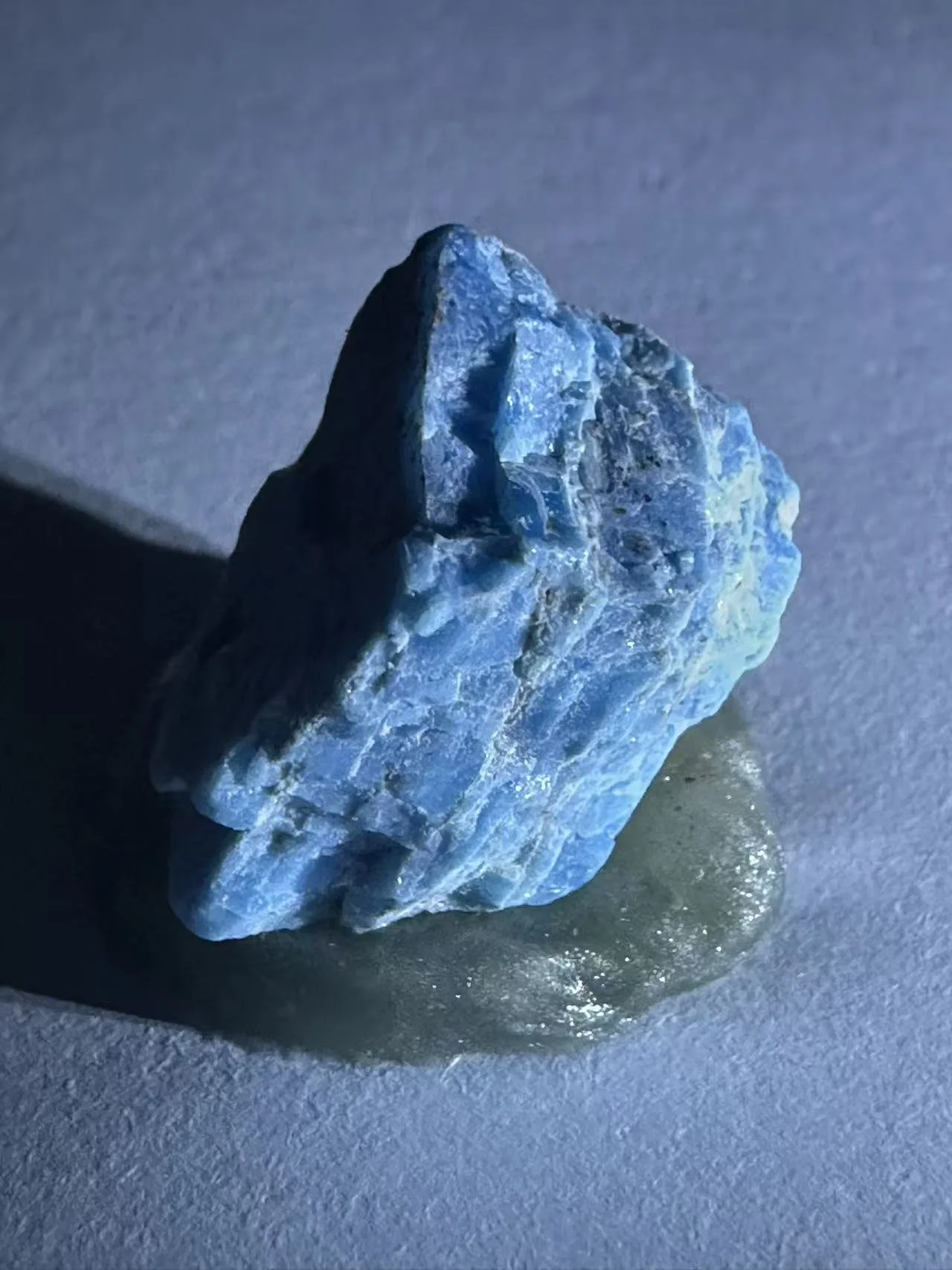
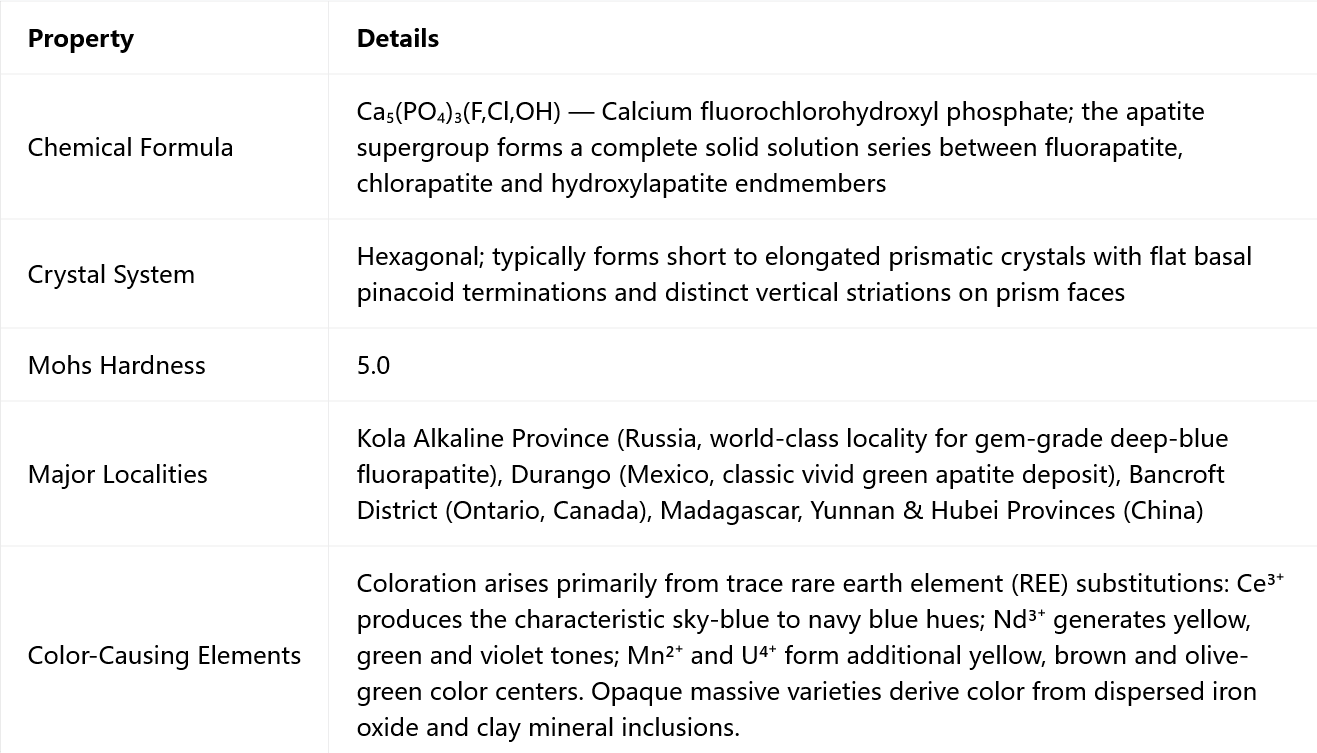
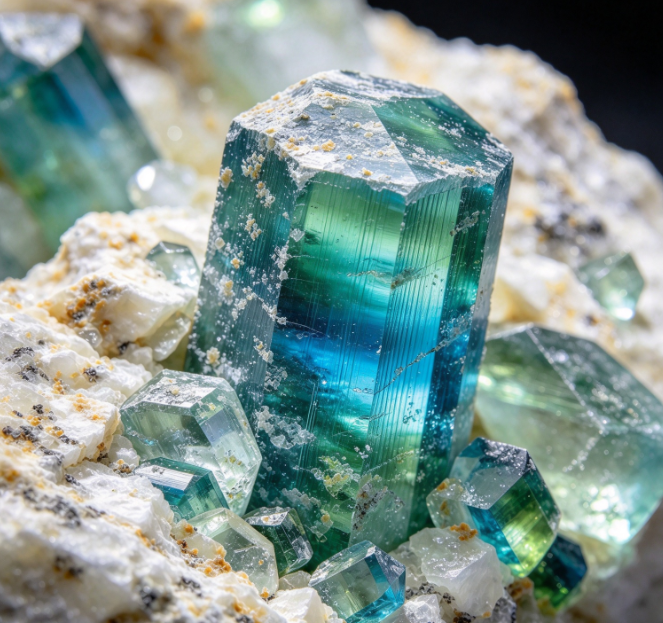
Apatite is the most abundant and geologically important phosphate mineral on Earth, and serves as the namesake type species of the apatite supergroup, a structurally diverse family of phosphate, arsenate and vanadate minerals. It crystallizes in the hexagonal system, most commonly developing prismatic crystal habits bounded by six prism faces and flat basal terminations. Well-formed crystals often exhibit fine parallel striations running vertically along the prism faces, and may occur as individual euhedral crystals, granular aggregates, or compact massive bodies. Fresh surfaces display a vitreous to subresinous luster, and the mineral possesses only imperfect basal cleavage, breaking with a typical conchoidal to uneven fracture.
Apatite forms under an exceptionally wide range of geological conditions. Gem-quality euhedral crystals occur most frequently in alkali igneous rocks, carbonatites and granitic pegmatites, where slow crystallization from phosphorus-rich magmatic fluids produces large, transparent, brightly colored specimens. It is also the dominant constituent of sedimentary phosphorite deposits, which form via biological and chemical precipitation in marine basins and constitute the world’s largest reserves of phosphate rock. In metamorphic environments, apatite occurs as a stable accessory mineral in both regionally and contact metamorphosed rocks.
The mineral exhibits extraordinary color diversity, ranging from colorless through white, yellow, green, blue, violet and brown. This chromatic range originates primarily from isomorphous substitution of calcium ions by trace rare earth elements within the crystal lattice. Cerium is the principal chromophore for the highly prized blue varieties, while neodymium, manganese and uranium produce the full spectrum of secondary hues. Many apatite specimens also exhibit strong fluorescence under ultraviolet light, a property widely used for exploration and identification. Biologically, hydroxylapatite is the primary inorganic component of vertebrate bones, teeth and dental enamel, making apatite one of the very few minerals that form a direct structural link between the geosphere and the biosphere.
Gemological & Industrial Applications
In the global gem and jewelry trade, transparent, vividly colored apatite single crystals are faceted into collector and fashion gemstones. The most valued varieties include the intense deep-blue fluorapatite from Russia’s Kola Peninsula, the bright grass-green apatite from Durango, Mexico, and the golden-yellow crystals from Madagascar. Rare chatoyant specimens are cut en cabochon to display a sharp cat’s-eye effect. With a Mohs hardness of only 5.0 and relatively low toughness, apatite is considered a relatively soft gemstone. It is best suited for protected jewelry settings such as pendants, earrings and brooches, and is not recommended for daily-wear rings where it would be subject to abrasion and impact. Fine euhedral crystal specimens are also highly sought after by mineral collectors.
Industrially, apatite is one of the most strategically critical mineral commodities in the world. Over 90% of global phosphate rock production is consumed by the agricultural sector to manufacture phosphate fertilizers, which underpin global food security by supplying the essential macronutrient phosphorus to crops. The remaining production feeds the chemical industry, where phosphate is processed into phosphoric acid and a vast array of phosphate compounds used in food additives, animal feed supplements, detergents, water treatment chemicals, flame retardants and industrial lubricants. In metallurgy, apatite is used as a flux in steel smelting and non-ferrous metal refining. In biomedical engineering, synthetic hydroxylapatite is manufactured into bone graft substitutes, dental implants and tissue engineering scaffolds, leveraging its identical chemical composition to human bone and excellent biocompatibility.
Cultural Significance
The name apatite derives from the Greek word apate, meaning “deception” or “fraud”, a reference to the mineral’s notorious ability to mimic the appearance of many other gem species. Early mineralogists named it for its tendency to be confused with beryl, topaz, quartz, olivine and tourmaline, a testament to its remarkable color and morphological diversity.
Historically, apatite has been used ornamentally for thousands of years. Carved apatite beads and amulets have been recovered from ancient Egyptian, Mesopotamian and Mesoamerican archaeological sites, though it never achieved the status of a cardinal gem due to its relative softness. In traditional folk lore, the stone was associated with clarity of vision and truth, believed to help the wearer see through deception and illusion.
In contemporary metaphysical and crystal healing traditions, apatite is widely known as the “Stone of Manifestation and Communication”. It is strongly associated with the throat chakra, and is believed to enhance clear self-expression, improve communication skills, stimulate creativity and support intellectual focus. Blue apatite is particularly linked to calm, articulate communication, while green apatite is associated with growth, healing and abundance.
Geologically and scientifically, apatite holds profound significance as the primary planetary reservoir of phosphorus — an element essential to all known life. It plays a central role in global biogeochemical cycles, and its isotopic and trace element composition is widely used by geoscientists to reconstruct ancient environments, trace magmatic evolution and date geological events. Within the mineral collecting community, well-formed prismatic apatite crystals in rare saturated colors remain prized cabinet specimens, celebrated for their perfect form, diverse palette and fundamental geological importance.