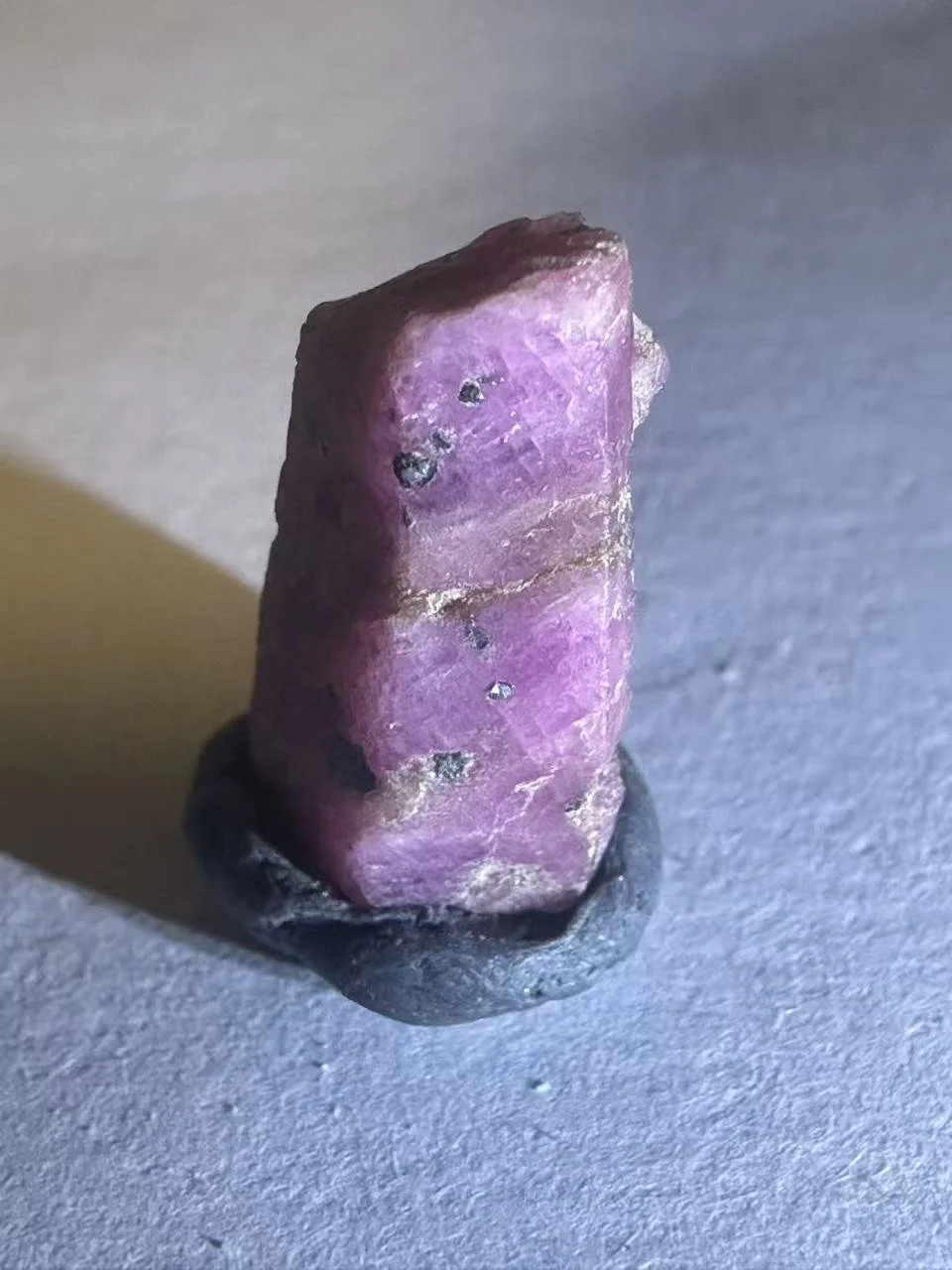
Red Corundum
Basic Properties of Red Corundum
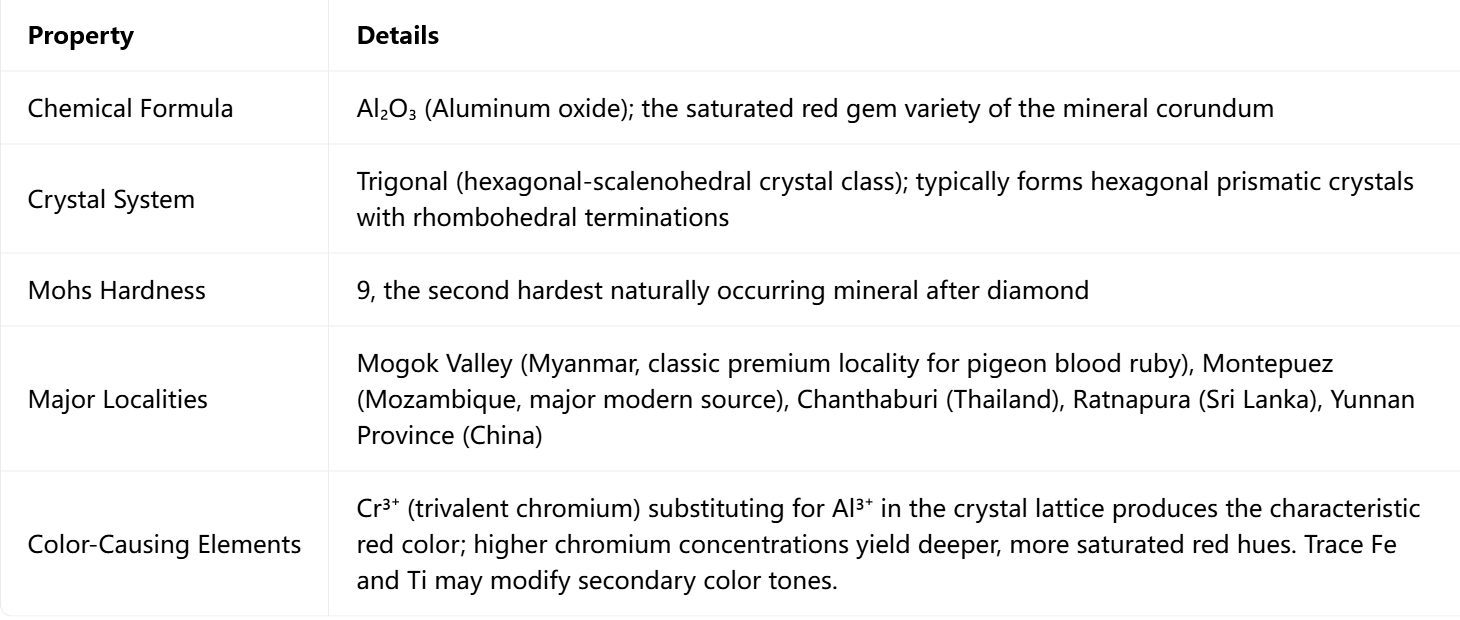
Mineral Characteristics
Red corundum, universally known by its gemological name ruby, is the saturated red gem variety of the mineral corundum, a naturally crystalline form of aluminum oxide. By strict gemological definition, only red corundum is classified as ruby; all other color varieties of corundum are categorized as sapphire. It crystallizes in the trigonal system, typically developing well-formed hexagonal prismatic crystals with flat rhombohedral terminations and prominent vertical striations on prism faces. Polysynthetic twinning along the basal plane is extremely common, producing a diagnostic basal parting that is a key identifying feature of the mineral. Fresh surfaces display a vitreous to subadamantine luster, and the mineral has no true cleavage but exhibits distinct parting in three directions.
Gem-quality ruby forms primarily through regional metamorphism of aluminum-rich calcareous sedimentary rocks, where it crystallizes within marble formations in association with calcite, dolomite, spinel and graphite. It also occurs in felsic pegmatites, as xenocrysts in alkaline basalts, and is frequently concentrated in secondary alluvial placer deposits formed by weathering and erosion of primary bedrock. Its characteristic red coloration arises from isomorphous substitution: trivalent chromium ions replace aluminum ions in the octahedral coordination sites of the corundum lattice. Chromium content directly controls color saturation, ranging from pale pinkish-red in low-chromium material to the legendary deep vivid crimson known as “pigeon blood” in top-grade specimens.
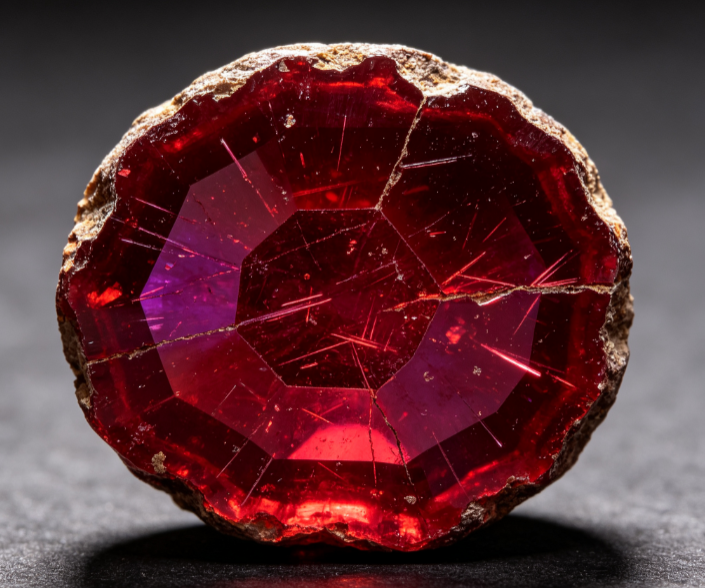
Internally, ruby typically contains diagnostic mineral inclusions that are used by gemologists to determine geographic origin. Oriented needle-like inclusions of rutile (TiO₂) are particularly characteristic; when aligned in three sets of parallel planes, they produce six-rayed asterism (the star effect), creating the highly valued star ruby variety. Other common inclusions include zircon, spinel, calcite and silk-like growth tubes, which form distinctive fingerprint patterns for each major deposit. Optically, ruby exhibits high refractive index, strong birefringence and moderate dispersion, giving well-cut stones exceptional brilliance and a vivid depth of color.
Gemological & Industrial Applications
In the global gem and jewelry industry, ruby is one of the five traditional “cardinal gems” (alongside diamond, emerald, sapphire and alexandrite), and is the official birthstone for the month of July. It is fashioned into both faceted gems and cabochons. Transparent, high-clarity material is almost always faceted — with oval, cushion and emerald cuts being the most popular — to maximize brilliance and color return. Stones exhibiting asterism are always cut en cabochon to display the six-rayed star effect. Quality is graded by color, clarity, carat weight and cut, with top-grade “pigeon blood” ruby from Myanmar’s Mogok Valley commanding the highest market prices. Fine material from Mozambique has also emerged as a premium modern source in recent decades. With a Mohs hardness of 9 and exceptional toughness, ruby is the most durable of all colored gemstones, making it ideally suited for all types of jewelry including daily-wear rings, pendants, earrings and high jewelry statement pieces.
Industrially, corundum including low-grade red corundum is one of the most critical industrial abrasive and engineering materials. Its extreme hardness, chemical inertness and high melting point make it indispensable for precision manufacturing. It is widely used as abrasive grains, grinding wheels, cutting tools and polishing media for metalworking, glass finishing and semiconductor fabrication. Synthetic ruby single crystals were the gain medium for the world’s first working laser, and remain a core material in solid-state lasers used in scientific research, medical devices and optical metrology. Red corundum is also used to manufacture precision mechanical bearings, high-temperature refractory components, and scratch-resistant optical windows for industrial and aerospace applications.
Cultural Significance
The name ruby derives from the Latin word ruber, meaning “red”, while the mineral name corundum traces back to the Sanskrit kuruvinda, meaning “ruby”. Throughout recorded human history, ruby has been revered as the king of gemstones, valued above all other colored stones for its deep fiery color and exceptional hardness.
In ancient civilizations, ruby was imbued with sacred and royal symbolism. Ancient Egyptians associated it with the sun god Ra and buried ruby amulets with pharaohs to ensure protection and eternal life. In ancient Greece and Rome, rubies were dedicated to the gods of war and worn by soldiers and rulers as talismans of courage, strength and victory. Across medieval Europe, ruby was believed to possess protective powers: it was thought to ward off evil, predict misfortune, heal blood disorders and safeguard health. In royal regalia across the world, rubies have been the centerpiece of crowns, scepters and imperial ornaments for millennia, symbolizing supreme power, dignity and wealth.
In contemporary culture, ruby remains the official July birthstone and the traditional gemstone for 15th and 40th wedding anniversaries, symbolizing passionate love, unwavering loyalty, vitality and courage. Within modern metaphysical and crystal healing traditions, ruby is regarded as the most powerful stone of vitality and manifestation, believed to boost energy, enhance confidence, attract success and abundance, and inspire passion and creativity. Its enduring status as the “king of gems” has persisted for over three thousand years, cementing its position as one of the most coveted and culturally significant gemstones on Earth.