Fluorite
Basic Properties of Fluorite
Mineral Characteristics
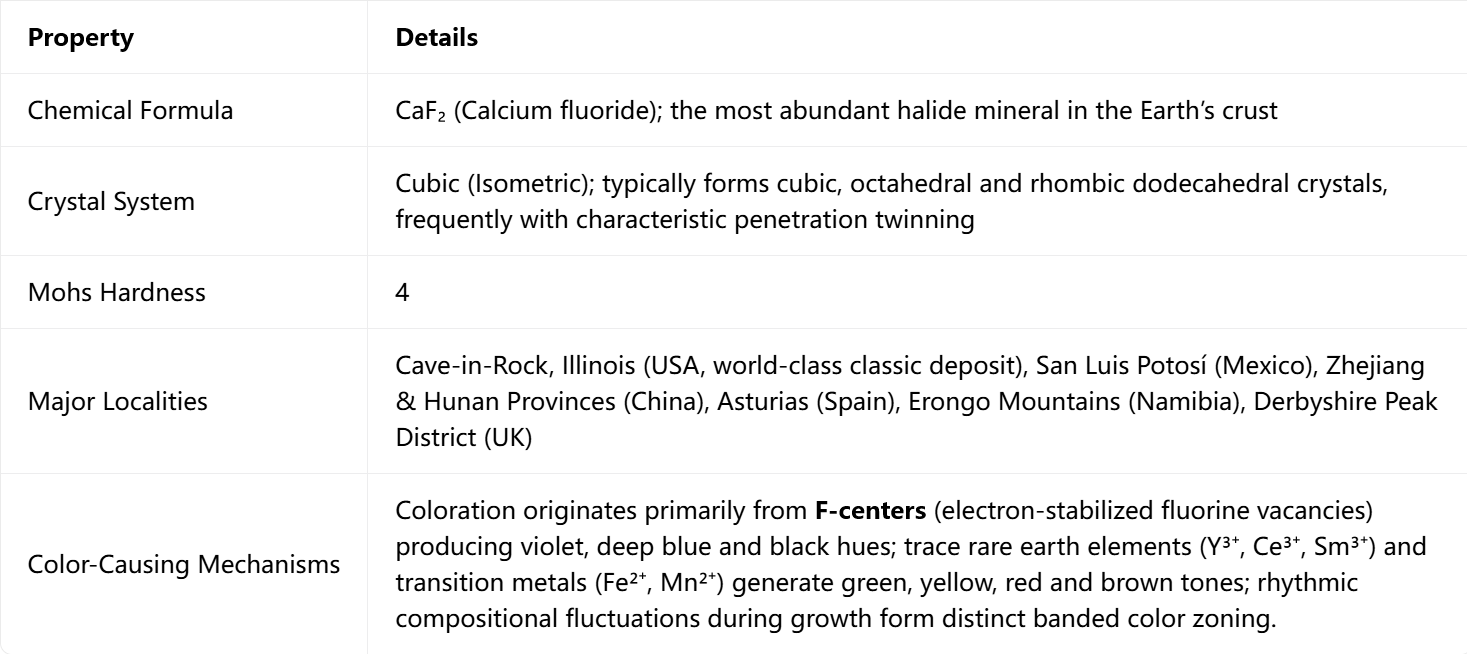
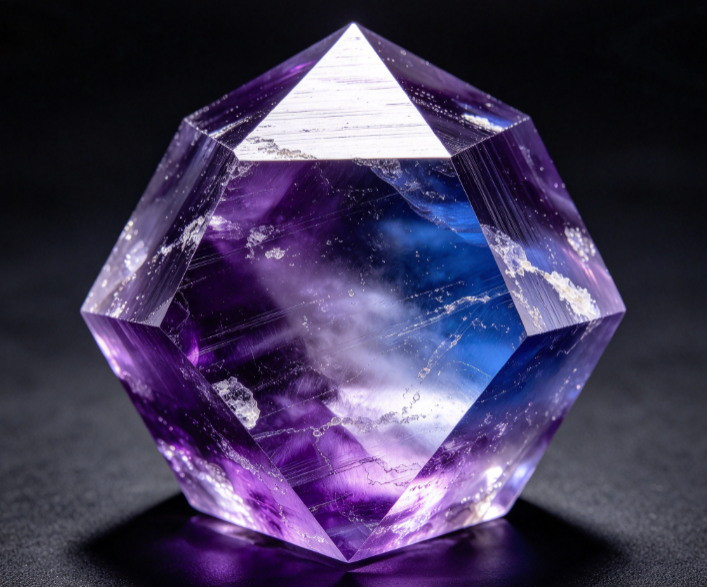
Fluorite is the archetypal member of the halide mineral group and one of the most structurally and optically distinctive minerals in the natural world. Crystallizing in the isometric system, it most commonly develops perfect cubic crystal habits, though octahedral, rhombic dodecahedral and combined polyhedral forms are also widespread. Its most diagnostic morphological feature is penetration twinning, where two intergrown cubic crystals intersect along their body diagonals, creating a symmetrical cross-shaped form that is a hallmark of the mineral. Fluorite possesses four sets of perfect octahedral cleavage, meaning that when fractured it consistently breaks along smooth planes to form regular octahedral fragments — a key identifying property for hand specimen identification. Fresh surfaces exhibit a vitreous luster, and the mineral ranges from transparent to translucent to opaque.
Fluorite forms under a wide range of geological conditions, but gem- and collector-quality crystals occur most frequently in low- to medium-temperature hydrothermal vein systems, where it precipitates from fluorine-bearing fluids in open cavities and fractures. It is commonly associated with quartz, calcite, sphalerite, galena and barite. It also occurs as a diagenetic and replacement mineral in carbonate sedimentary rocks, and as an accessory phase in granitic pegmatites.
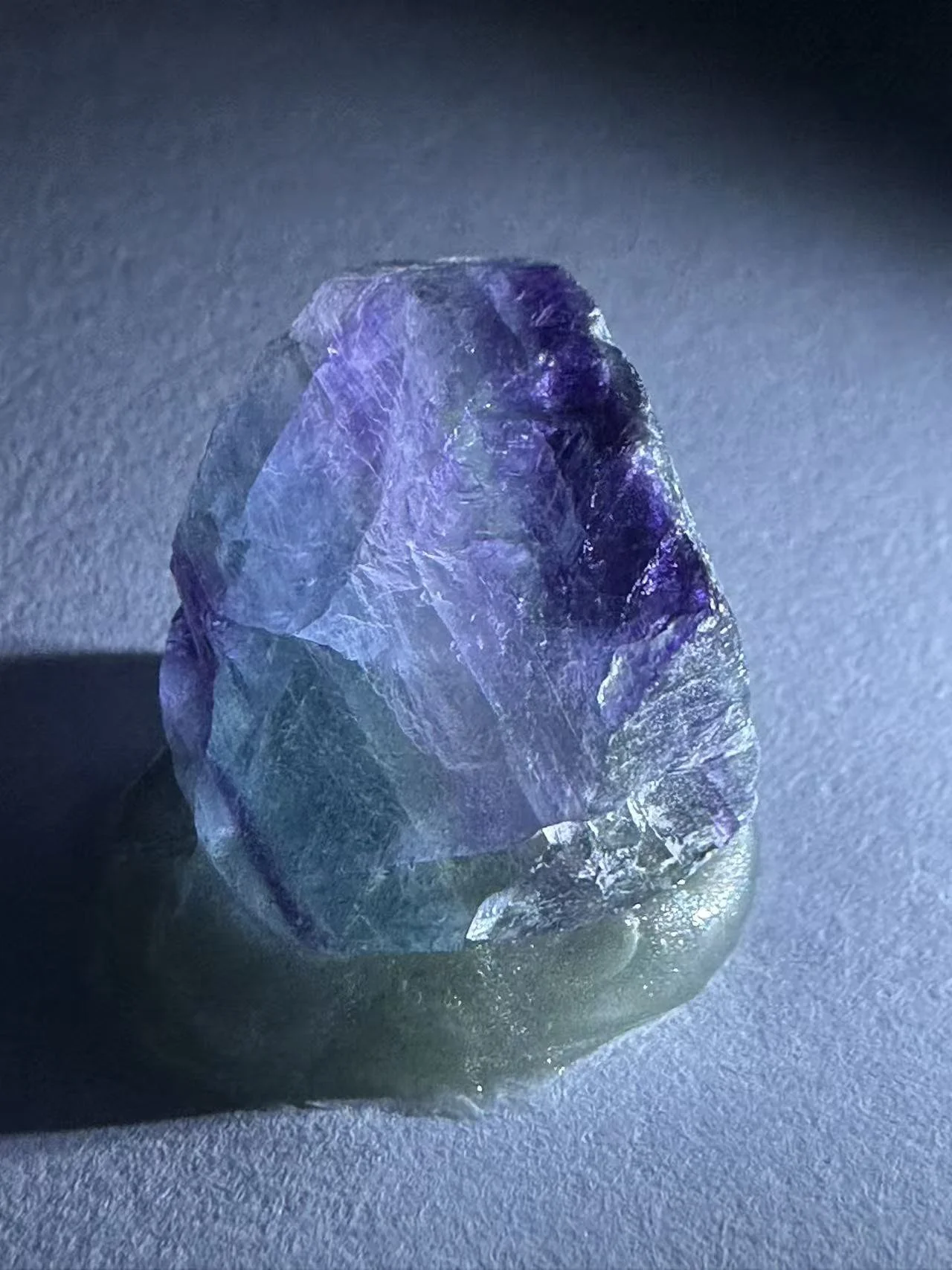
Fluorite is famous for exhibiting the greatest color diversity of any mineral species, with specimens known in nearly every hue of the visible spectrum. This extraordinary chromatic variation stems from multiple mechanisms. The most important is the formation of color centers (F-centers), where electrons become trapped in fluorine ion vacancies within the crystal lattice, absorbing specific wavelengths of light to produce deep violet and blue colors. Rare earth element impurities substituting for calcium generate yellow, green and red shades, while organic inclusions and radiation damage can produce additional brown and black tones. Many specimens develop prominent concentric color banding, recording changes in fluid chemistry during episodic crystal growth.
Optically, fluorite is renowned for its strong fluorescence under ultraviolet light — the phenomenon of fluorescence was in fact named after fluorite by the 19th-century physicist George Stokes, who first systematically described the effect in this mineral. Many varieties also exhibit thermoluminescence, triboluminescence and, in rare cases, persistent phosphorescence after exposure to light.
Gemological & Industrial Applications
In gemology, fluorite is a popular ornamental and collector gemstone, though its low Mohs hardness of 4 and perfect cleavage make it unsuitable for daily-wear ring settings. It is most commonly fashioned into polished cabochons, beads, pendants, earrings and ornamental carvings. Exceptionally transparent, inclusion-free specimens are faceted into collector gemstones, with fine saturated violet, emerald-green and cornflower-blue varieties commanding the highest premiums. Banded “rainbow fluorite” with sharp, multicolored growth zoning is highly prized for cabochons and decorative slices, while rare phosphorescent varieties have historical and cultural significance as the material behind many traditional “night-pearl” legends. Due to its softness, fluorite is also a favorite material for ornamental carvings, bookends and decorative spheres.
Industrially, fluorite is one of the most strategically important industrial minerals in the world, serving as the primary global source of fluorine and the foundation of the entire fluorochemical industry. Over 90% of mined fluorite is consumed by industrial sectors:
Metallurgy: Used as a flux in iron and steel smelting and non-ferrous metal refining, where it lowers the melting point of slag, improves fluidity and removes impurities.
Chemical industry: The principal feedstock for the production of hydrofluoric acid (HF), the base material for refrigerants, fluoropolymers, fluororubbers, pharmaceuticals, agrochemicals and lithium battery electrolytes.
Optics: High-purity optical-grade fluorite is manufactured into low-dispersion lenses and prisms for cameras, microscopes, telescopes and spectrometers, where its exceptionally low chromatic aberration enables superior image quality.
Ceramics & construction: Used as a flux and opacifier in ceramic glazes, enamels and cement production.
Cultural Significance
The name fluorite derives from the Latin word fluere, meaning “to flow”, a reference to its long-established use as a metallurgical flux that improves the fluidity of molten slag. This practical industrial property gave the mineral its name long before its gemological and optical properties were widely studied.
Fluorite holds a unique place in the history of physics: in 1852, Sir George Stokes named the phenomenon of fluorescence directly after fluorite, making it one of the very few minerals to lend its name to a fundamental physical effect. This discovery cemented fluorite’s scientific and cultural legacy far beyond geology.
Historically, fluorite has been used ornamentally for millennia. In ancient Rome, intensely colored fluorite was carved into luxury drinking vessels known as murrhine cups, which were among the most prized possessions of the elite and were believed to protect against intoxication. In imperial China, carved fluorite ornaments and snuff bottles were valued by scholars and nobles, and phosphorescent fluorite specimens gave rise to the enduring legend of the luminous “night pearl”.
In contemporary metaphysical and crystal healing traditions, fluorite is widely known as the “Stone of Focus and Mental Clarity”. It is believed to organize scattered thought, enhance concentration, support decision-making and cleanse stagnant energy. Different colors carry specific associations: green fluorite is linked to emotional balance and heart-centered awareness, purple fluorite to intuition and spiritual insight, and blue fluorite to calm communication.
Within the global mineral collecting community, fluorite is one of the most beloved and widely collected species, celebrated for its perfect crystal form, extraordinary color range and abundance of classic localities. Fine cabinet specimens from historic deposits remain cornerstones of both museum and private mineral collections worldwide.