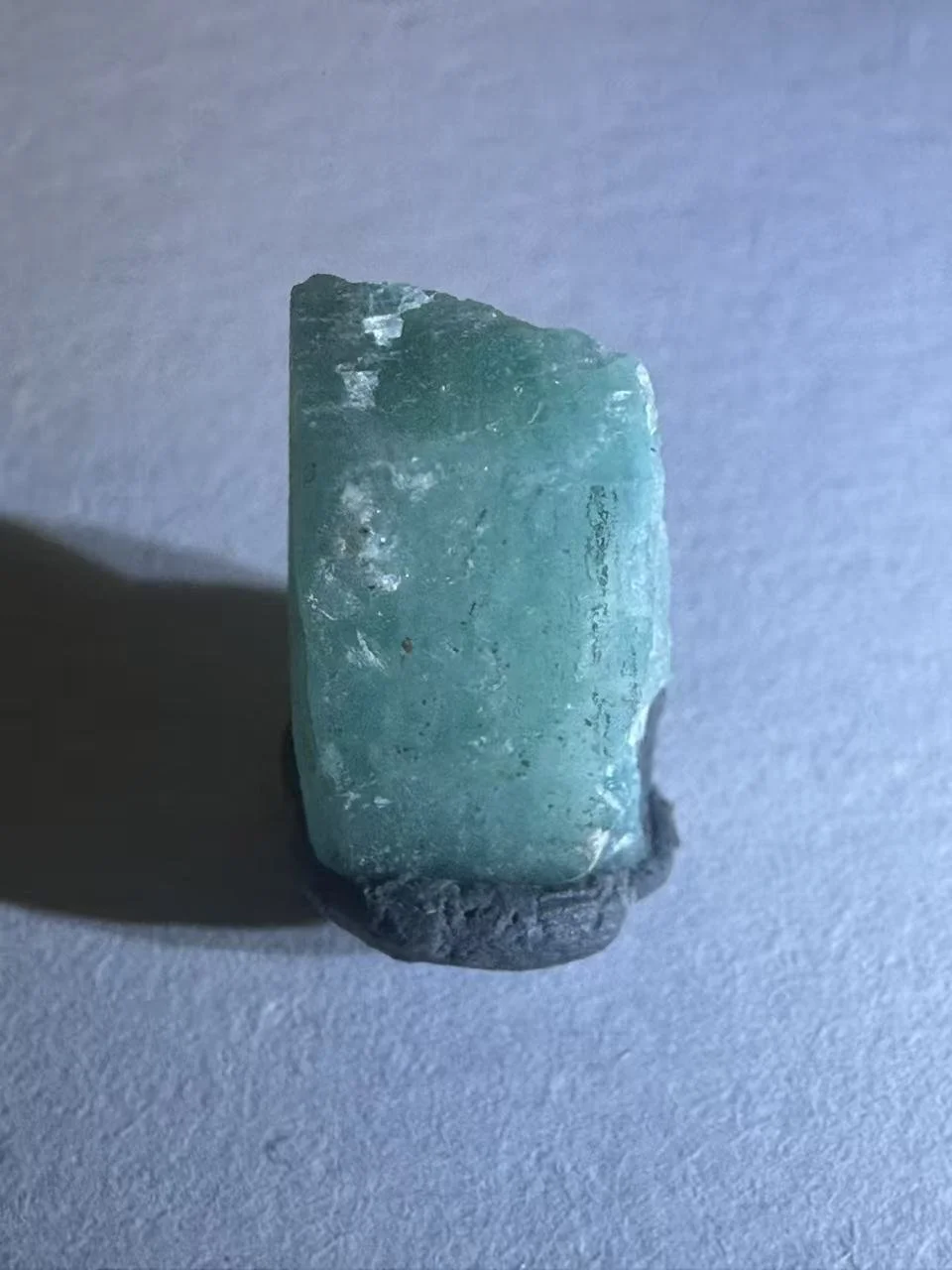
Amazonite
Basic Properties of Amazonite
Mineral Characteristics
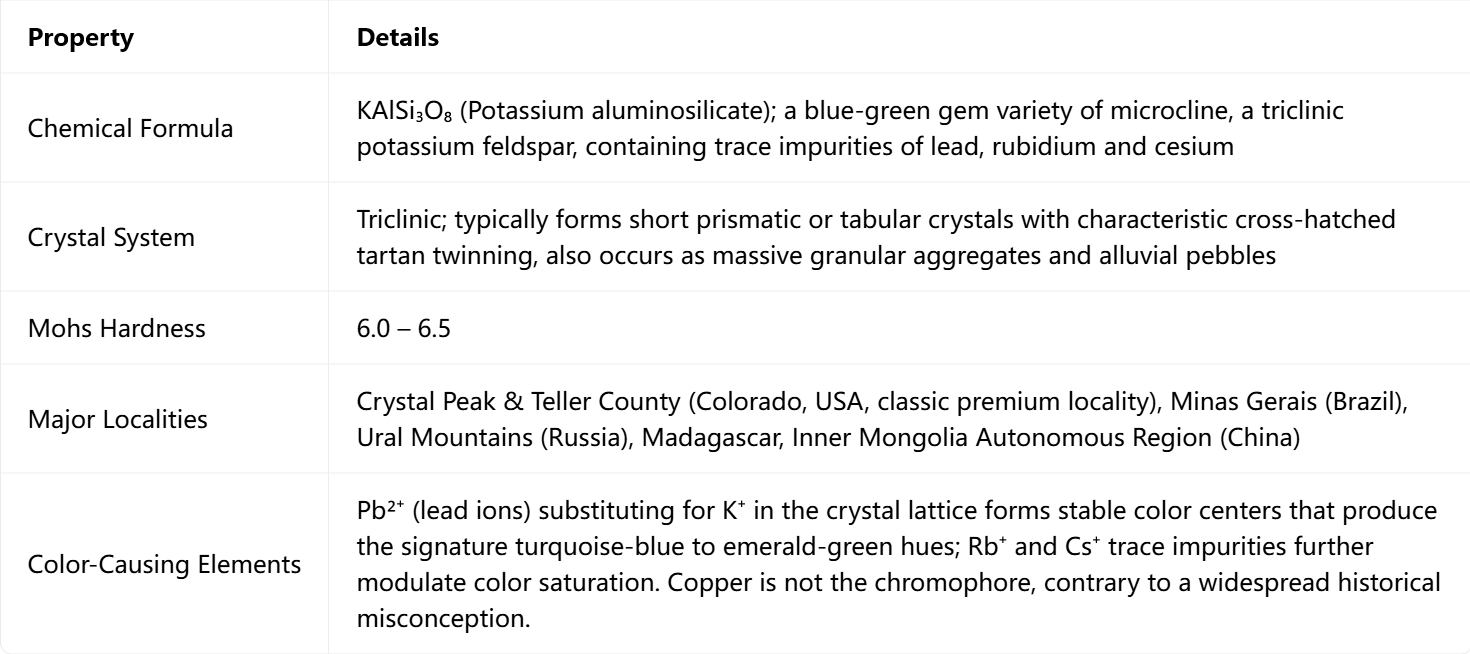
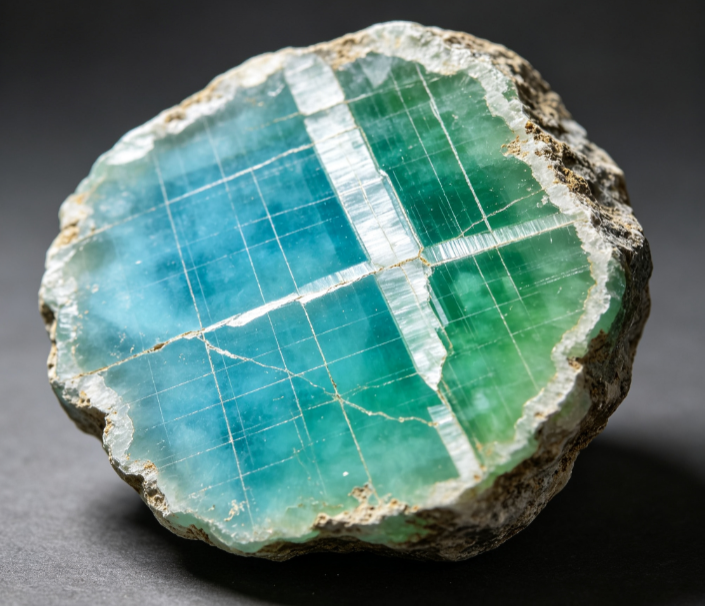
Amazonite is the iconic blue-green gem variety of microcline, a triclinic potassium feldspar mineral, and is not recognized as a distinct mineral species. It crystallizes in the triclinic system, most commonly developing short prismatic or tabular crystal habits distinguished by a diagnostic cross-hatched pattern known as tartan twinning — a polysynthetic twinning along two perpendicular sets of planes that creates a fine grid-like structure visible under magnification. The mineral exhibits two sets of nearly perpendicular perfect cleavage, a vitreous to pearly luster on cleavage surfaces, and a conchoidal fracture.
Gem-quality amazonite forms primarily in open cavities within granitic pegmatites and high-temperature hydrothermal vein systems, where slow crystallization allows for the growth of large, uniformly colored crystals. It is also frequently recovered as rounded alluvial pebbles from secondary placer deposits formed by weathering and erosion of pegmatite bodies. The characteristic blue-green coloration was long incorrectly attributed to copper impurities, but modern spectroscopic studies have confirmed that it arises from stable color centers formed when Pb²⁺ ions isomorphously replace K⁺ ions within the feldspar crystal lattice. Trace amounts of rubidium and cesium also substitute for potassium, influencing the depth and saturation of the color, which ranges from pale sky-blue through vivid turquoise to deep forest-green. High-grade material displays uniform, saturated emerald-green color with minimal white feldspar veining and strong translucency.
Gemological & Industrial Applications
Within the global gem and jewelry trade, amazonite is valued for its distinctive soft turquoise-green hue, wide availability and approachable price point. It is most commonly fashioned into polished cabochons, round beads for bracelets, pendants, and ornamental carvings. Due to its two perfect cleavage planes, faceted amazonite is relatively uncommon, and clean, highly transparent faceted stones are sought after by gem collectors. With a Mohs hardness of 6.0–6.5, it is suitable for regular wear in pendants, earrings and beads, though care should be taken to avoid sharp impact and heavy abrasion to prevent chipping along cleavage planes. Classic deep-green amazonite from Colorado, USA, commands the highest market premium and is considered the benchmark for top-quality material. Well-preserved euhedral crystal specimens are also highly prized in the mineral collecting community.
Industrially, low-grade microcline feldspar ore is a high-volume industrial mineral with broad applications. It serves as a primary fluxing agent in the manufacture of ceramics, porcelain and sanitary ware, lowering firing temperatures and improving vitrification. It is also a key raw material in glass production, enamel glazes, paint and rubber fillers, and is used as a decorative dimension stone for interior cladding and architectural features. Gem-quality amazonite is reserved exclusively for lapidary, ornamental and collector use.
Cultural Significance
The name amazonite derives from an 18th-century geological misconception: early mineralogists mistakenly believed the stone originated from the Amazon River basin in South America, and named it accordingly. In reality, no significant amazonite deposits exist in the Amazon region, but the name has remained the standard term ever since.
Historically, amazonite has been used by human civilizations for over three thousand years. Ancient Egyptians carved it into amulets, beads and scarabs, associating it with protection, good fortune and spiritual balance. It was also used in Mesopotamian and ancient Middle Eastern cultures for decorative objects and seal stones, valued for its calming green-blue color and perceived protective properties.
In contemporary metaphysical and crystal healing traditions, amazonite is widely known as the “Stone of Communication and Truth”. It is believed to soothe nervous tension and anxiety, calm emotional turbulence, and promote clear, honest, empathetic self-expression. It is also strongly associated with luck, abundance and harmony, thought to attract positive opportunities and balance conflicting energies. It is often cited as a supporting stone for the zodiac signs of Virgo and Aquarius, and remains one of the most popular blue-green ornamental stones in modern crystal and jewelry culture.