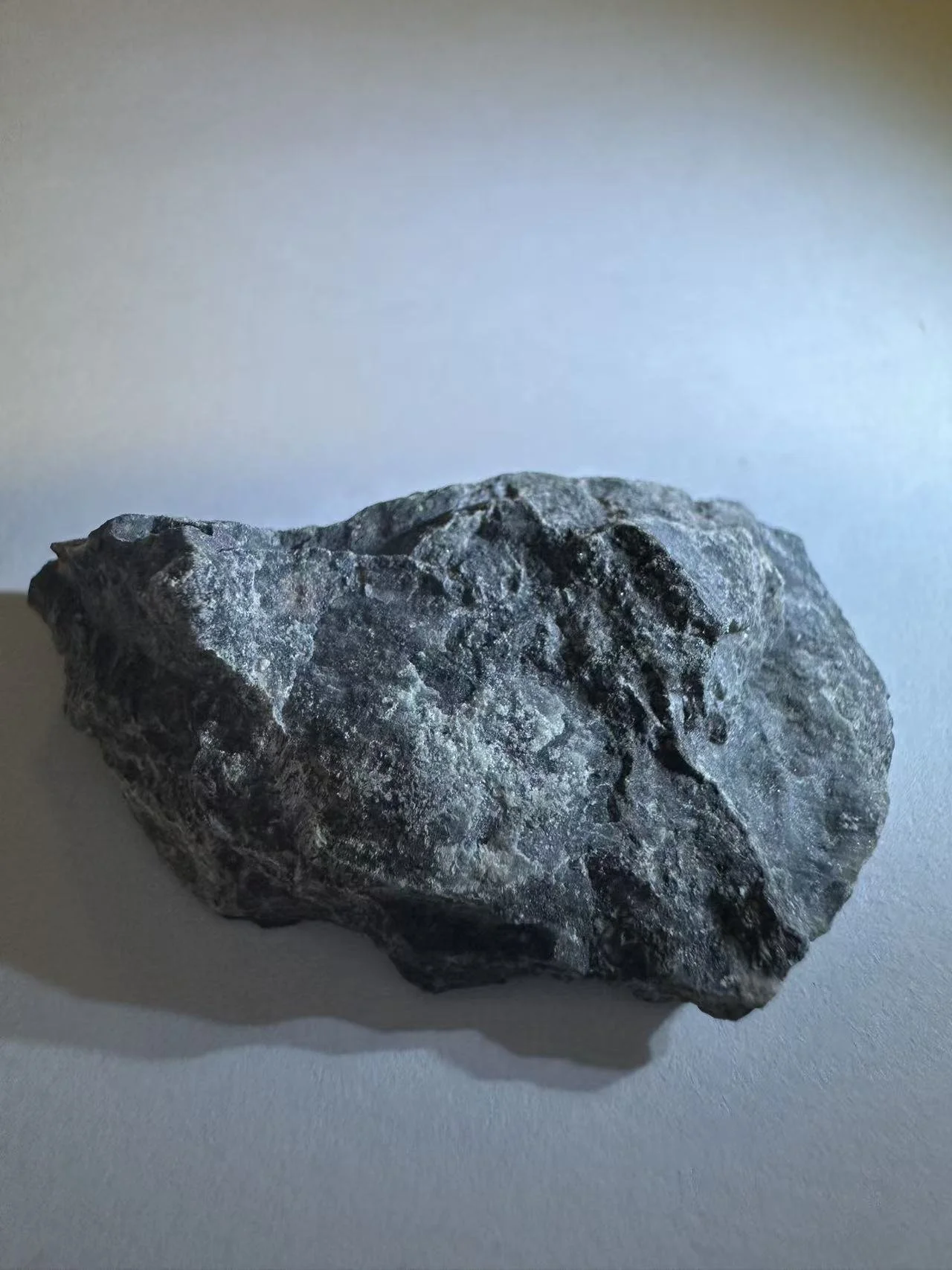
Pyrophyllite
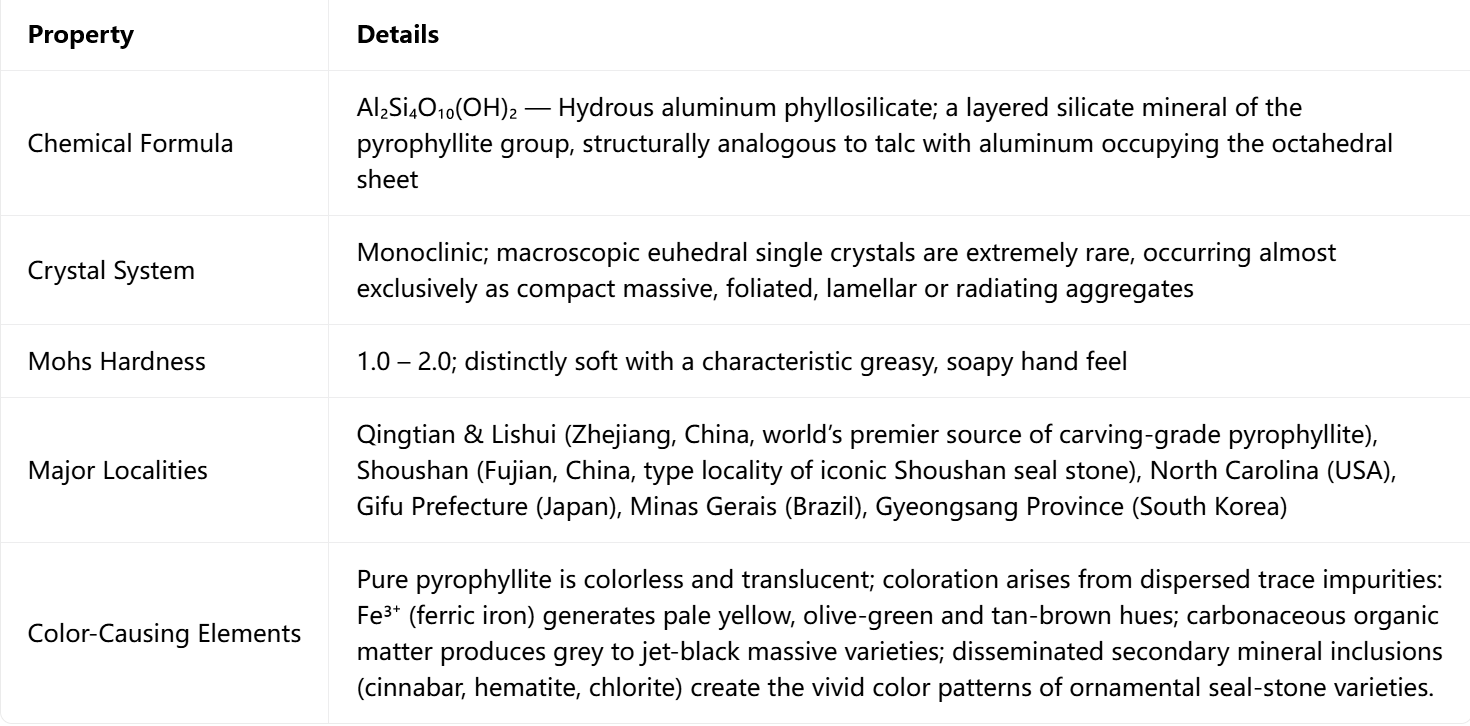
Basic Properties of Pyrophyllite
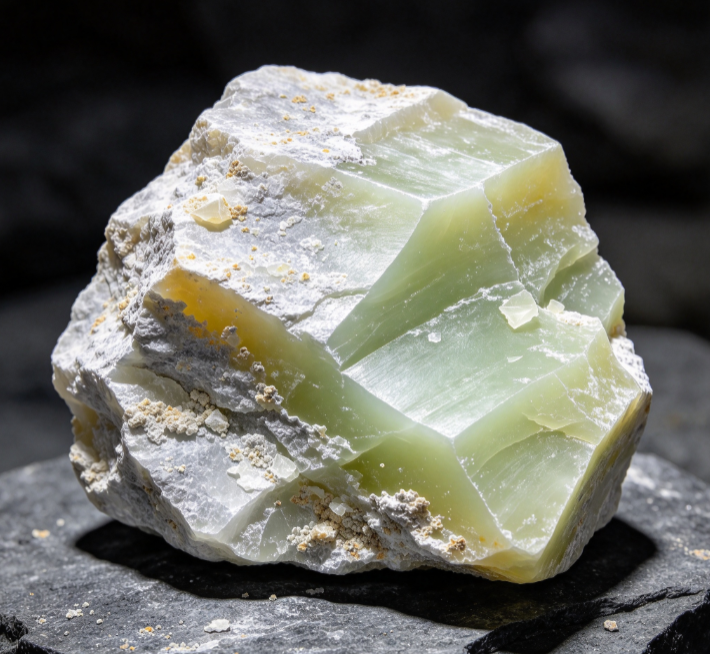
Mineral Characteristics
Pyrophyllite is a hydrous aluminum phyllosilicate mineral and the namesake member of the pyrophyllite group, a class of layered silicates defined by their stacked tetrahedral-octahedral-tetrahedral (T-O-T) sheet structure with no interlayer cations. It crystallizes in the monoclinic system, but well-formed euhedral single crystals are exceptionally rare in nature. The vast majority of occurrences take the form of dense, fine-grained massive aggregates, foliated lamellar masses, radiating bladed clusters or earthy compact bodies. When perfectly cleaved, it forms thin, flexible but inelastic folia — a key feature distinguishing it from mica, which exhibits elastic cleavage flakes. Fresh cleavage surfaces display a pearly luster, while massive polished material shows a vitreous to waxy or greasy luster. The mineral possesses a single perfect basal cleavage and breaks with a flaky to uneven fracture, and its characteristically soft, soapy texture is one of its most diagnostic field properties.
Pyrophyllite forms primarily through low- to medium-temperature hydrothermal alteration of aluminum-rich igneous and sedimentary rocks, most commonly granites, rhyolites, tuffs and argillaceous sediments. It is also a product of low-grade regional metamorphism of pelitic rocks, and occurs as a common alteration mineral in epithermal vein systems. It is typically associated with quartz, kaolinite, dickite, sericite, chlorite and feldspar. Deposit quality and texture vary dramatically: fine-grained, uniformly dense, fracture-free masses form premium carving-grade material, while coarse, porous, impurity-rich material is reserved for industrial use. A notable diagnostic property is its thermal behavior: pyrophyllite exfoliates and expands into delicate leaf-like fragments at high temperatures, a characteristic that inspired its scientific name.
Gemological & Industrial Applications
In gemological and ornamental contexts, pyrophyllite is not typically faceted as a gemstone, but holds exceptional cultural and economic importance as the primary mineral constituent of the world’s most revered traditional seal stones. It is the dominant rock-forming mineral of three of China’s great classical seal stones — Shoushan stone, Qingtian stone and Balin stone — celebrated for millennia as premium materials for scholar’s seals and ornamental carving. High-grade varieties with uniform texture, saturated color and freedom from fractures are carved into intricate figurines, landscape pieces and, most prestigiously, traditional Chinese calligraphy seals. The rarest and most valuable varieties include golden-yellow Tianhuang stone and cinnabar-bearing Chicken Blood stone, both pyrophyllite-dominated rocks that rank among the most expensive ornamental stones on Earth by weight. Fine-grained pyrophyllite is also fashioned into beads, cabochons and decorative objects for contemporary jewelry and mineral collections.
Industrially, pyrophyllite is a high-volume, versatile industrial mineral valued for its chemical inertness, high thermal stability, low thermal conductivity, electrical insulating properties and lubricity. It is one of the primary raw materials for the ceramic industry, where it acts as a flux and filler in sanitary ware, floor tiles and refractory ceramics, lowering firing temperatures and improving dimensional stability. It is also widely used as a functional filler in paper, paints, rubber, plastics and cosmetics, where it improves smoothness, opacity, heat resistance and wear resistance. In metallurgy, it serves as a high-temperature mold release agent and refractory lining material. Additional applications include glass fiber manufacturing, production of synthetic mica and molecular sieves, and as a substrate in environmental filtration systems.
Cultural Significance
The name pyrophyllite derives from the Greek words pyr (fire) and phyllon (leaf), referring to the mineral’s characteristic tendency to exfoliate into delicate leaf-like fragments when heated. This thermal property gave the mineral its formal scientific name in the early 19th century, though its human use stretches back thousands of years.
Within Chinese cultural history, pyrophyllite occupies a singular position as the foundation of seal carving culture, one of the core arts of traditional Chinese scholarship. For over two thousand years, seals carved from pyrophyllite-based stone have served as official instruments of authority, authentication and artistic expression, intimately tied to calligraphy, painting and literati culture. Premium varieties such as Tianhuang (“field yellow”) have been revered as the “Emperor of Stones” since imperial times, with a value historically exceeding gold by weight, symbolizing integrity, literary accomplishment and noble character. The art of seal carving on pyrophyllite stone remains a living classical art form and a cornerstone of Chinese cultural heritage.
In contemporary metaphysical and crystal healing traditions, pyrophyllite is regarded as a stone of calm, inner peace and emotional gentleness. Its soft, smooth texture is symbolically linked to soothing tension, reducing anxiety and facilitating quiet reflection. It is often used in meditation practices to support grounding and centeredness. Within the global mineral collecting community, fine carved pyrophyllite art objects and well-formed foliated specimens are highly prized, celebrated for their historical significance, remarkable texture and subtle natural beauty.