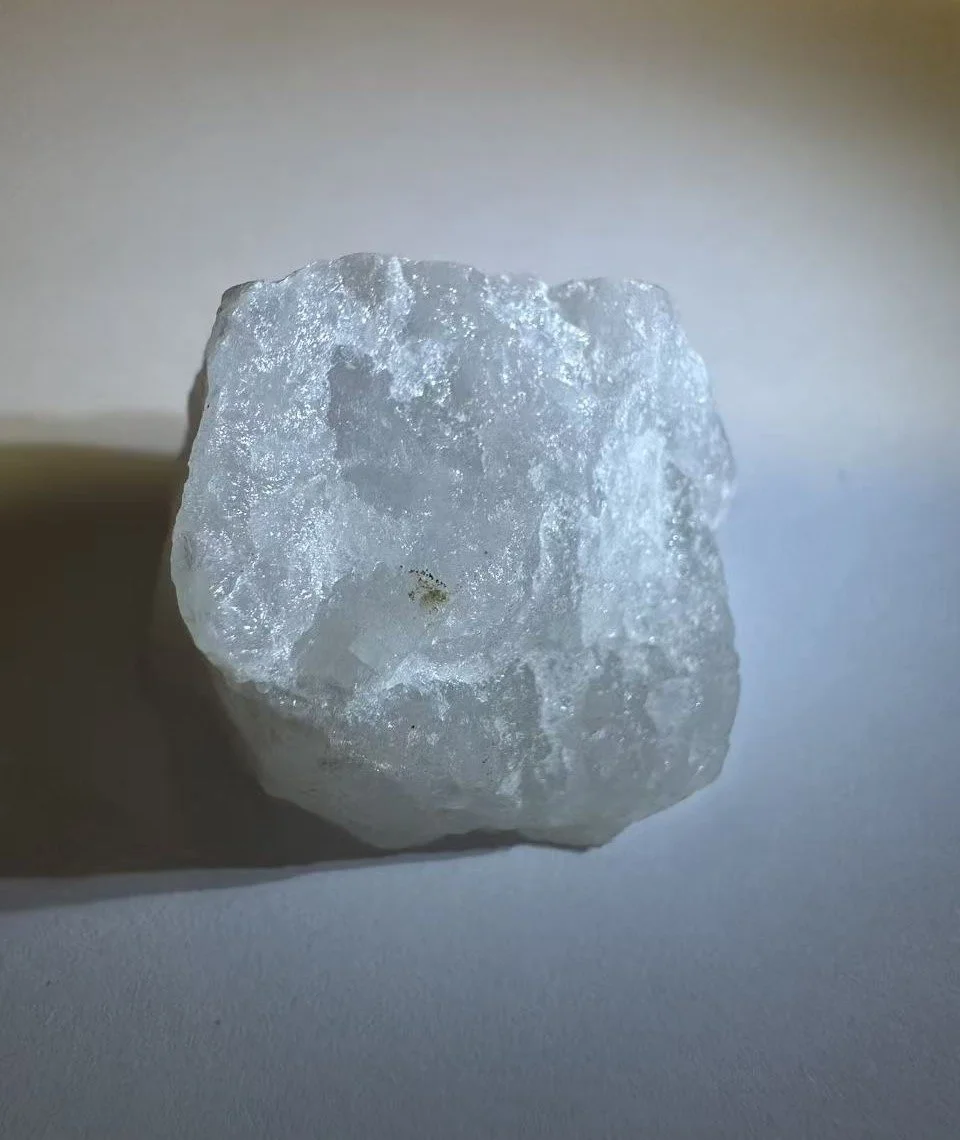
Quartz
Basic Properties of Quartz
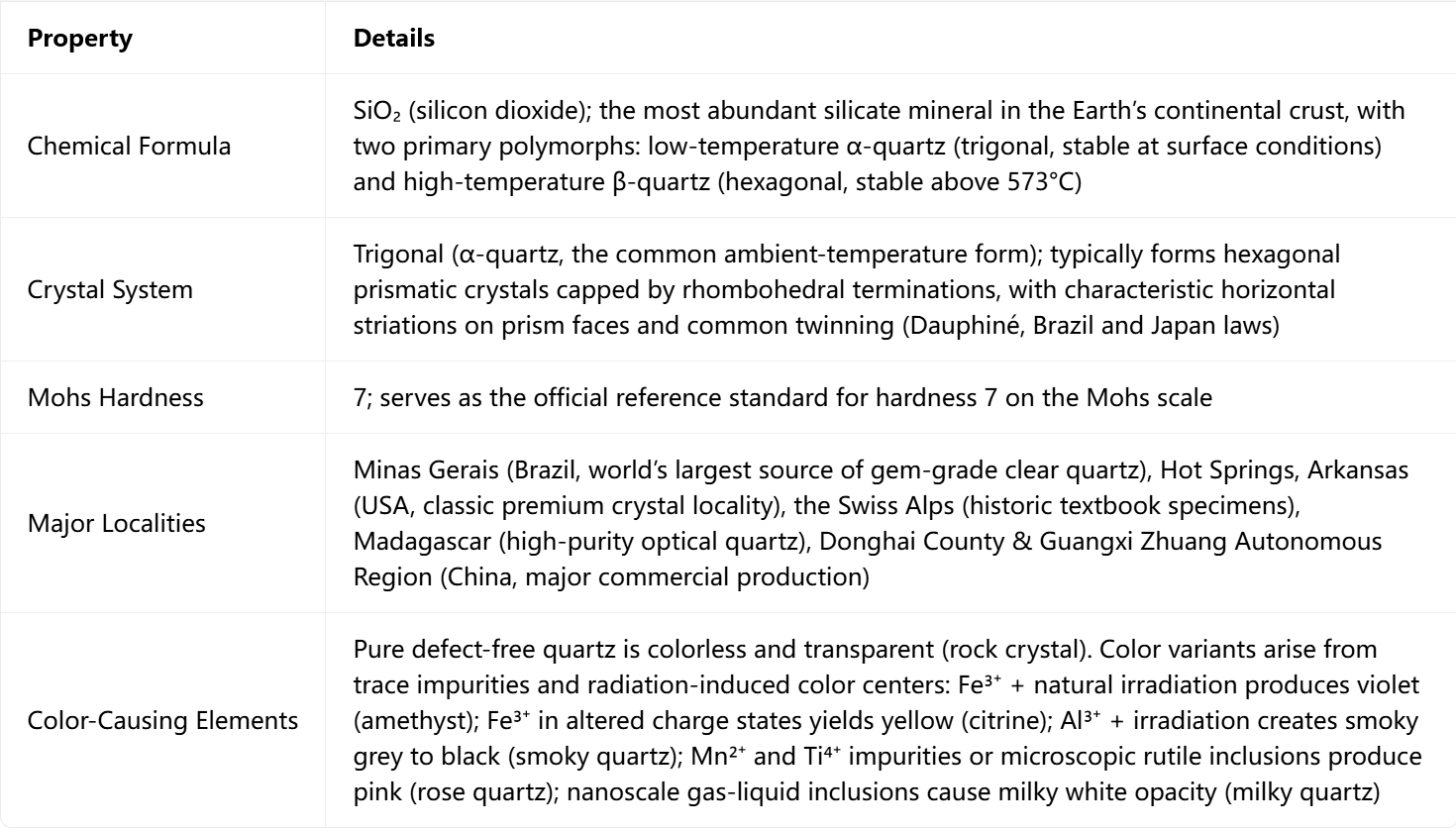
Mineral Characteristics
Quartz is the second most abundant mineral in the Earth’s continental crust and the single most geologically widespread mineral species, occurring in nearly every geological environment across all three major rock classes (igneous, sedimentary and metamorphic). It belongs to the tectosilicate (framework silicate) group, with a crystal structure built from a three-dimensional network of interlocking SiO₄ tetrahedra. At standard surface temperature and pressure, the stable polymorph is α-quartz, which crystallizes in the trigonal system; above 573°C at atmospheric pressure, it reversibly transforms to hexagonal β-quartz, a high-temperature form rarely preserved in surface rocks.
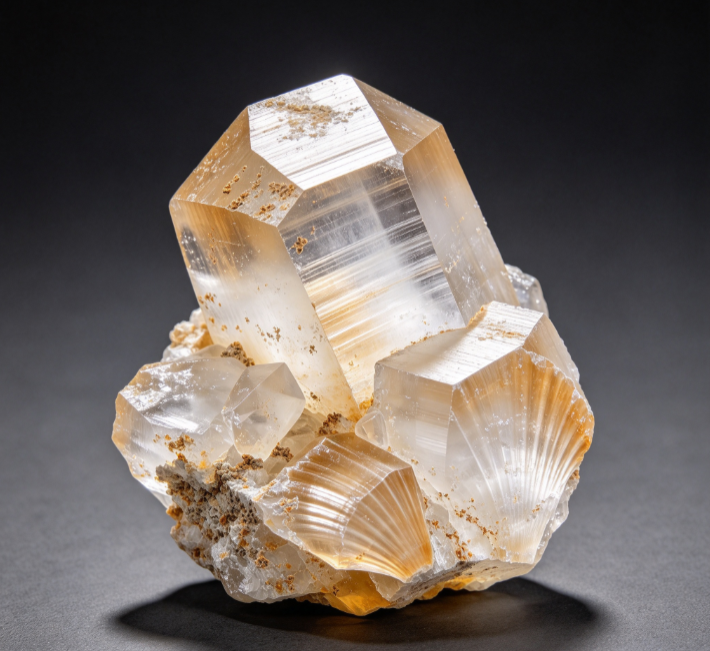
Well-formed euhedral quartz crystals typically exhibit a distinctive habit consisting of a six-sided hexagonal prism capped by two sets of three rhombohedral faces that form a pyramidal termination. Prism faces characteristically display fine horizontal striations formed by alternating growth of prism and rhombohedral faces during crystallization. Polysynthetic and contact twinning are extremely common, with three principal twin laws — Dauphiné, Brazil and Japan — that serve as diagnostic identification features for the mineral. Quartz exhibits no true cleavage, breaking instead with a characteristic conchoidal fracture that produces smooth, curved surfaces with a greasy luster; fresh crystal faces display a vitreous luster.
Gem-quality transparent quartz crystals form most abundantly in open cavities within granitic pegmatites and high-temperature hydrothermal vein systems, where slow, unimpeded growth allows the development of large, inclusion-free euhedral crystals. It also occurs as an essential rock-forming mineral in granites, rhyolites, sandstones, cherts and metamorphic rocks such as quartzite and gneiss, and is concentrated in secondary alluvial placer deposits as rounded water-worn pebbles. Quartz exhibits greater morphological and varietal diversity than almost any other mineral species, with dozens of recognized varieties divided into two broad categories: macrocrystalline (visible individual crystals) including rock crystal, amethyst, citrine, smoky quartz and rose quartz; and microcrystalline/cryptocrystalline (submicroscopic grain aggregates) including chalcedony, agate, jasper and flint. A notable physical property of α-quartz is piezoelectricity — the generation of an electrical charge in response to mechanical stress — resulting from its asymmetric crystal structure.
Gemological & Industrial Applications
In the global gem and jewelry industry, quartz is the most widely used and versatile gem material by volume, valued for its excellent durability, wide color range and global availability. Macrocrystalline varieties are fashioned into every form of jewelry: transparent clean material is faceted into all standard cuts for rings, pendants and earrings, while translucent and opaque varieties are cut as cabochons, carved into ornaments and fashioned into round beads for bracelets and necklaces. Amethyst (violet), citrine (yellow), rose quartz (pink) and smoky quartz are the most commercially important gem varieties, each with distinct market demand. Rare chatoyant or asteriated varieties, caused by aligned needle-like rutile inclusions, are cut en cabochon to display cat’s-eye or star effects. With a Mohs hardness of 7 and good toughness, quartz is highly scratch-resistant and suitable for daily wear in all jewelry settings.
Industrially, quartz is one of the most strategically critical mineral commodities in the modern world, with applications spanning nearly every sector of manufacturing and technology. High-purity single-crystal quartz leverages its piezoelectric property to manufacture frequency control devices, crystal oscillators, filters and timing components for consumer electronics, telecommunications, aerospace, navigation systems and quartz clocks — an invention that revolutionized precision timekeeping. Ultra-high-purity fused silica is the foundation material for optical fibers, semiconductor manufacturing substrates, precision lenses, laboratory glassware and high-temperature optical components, valued for its exceptional chemical inertness, thermal stability and broad spectral transmission. Bulk industrial quartz sand is the primary feedstock for the global glass industry, and is also used in ceramics, foundry molds, construction materials, water filtration media and industrial abrasives.
Cultural Significance
The name quartz derives from the German word Quarz, which likely traces back to a Slavic root meaning “hard”, a reference to its notable scratch resistance. The mineral has been known and used by human societies for well over ten thousand years, with deep cultural and symbolic significance across nearly every civilization.
In ancient civilizations, clear rock crystal was imbued with profound mythic meaning. The ancient Greeks named it krystallos, meaning “ice”, believing it to be eternally frozen water from the gods, and carved it into ritual vessels and amulets. Ancient Egyptians used quartz beads and carvings in funerary jewelry and protective talismans, associating it with eternal life and divine protection. In imperial China, rock crystal — known as shui yu (“water jade”) — was carved into ritual vessels, scholar’s objects and imperial ornaments, revered as a symbol of purity, clarity and wisdom. Indigenous cultures across the Americas and Australia used quartz crystals in healing ceremonies, vision quests and spiritual rituals, believing them to hold sacred life force and the ability to channel spiritual energy.
In contemporary metaphysical and crystal healing traditions, quartz is regarded as the “master stone” and the most versatile of all healing crystals. Different color varieties carry specific associations: clear rock crystal is linked to purification, amplification and spiritual clarity; amethyst to wisdom, calm and intuition; citrine to abundance, creativity and success; rose quartz to love, compassion and emotional healing; and smoky quartz to grounding, protection and release.
Scientifically, the discovery of the piezoelectric effect in quartz transformed 20th-century technology, enabling the development of radio, radar, precision timing and modern computing. Within the global mineral collecting community, well-formed euhedral quartz crystals in rare colors and distinctive habits remain among the most popular and widely collected specimens, celebrated for their perfect form, exceptional diversity and fundamental geological significance.