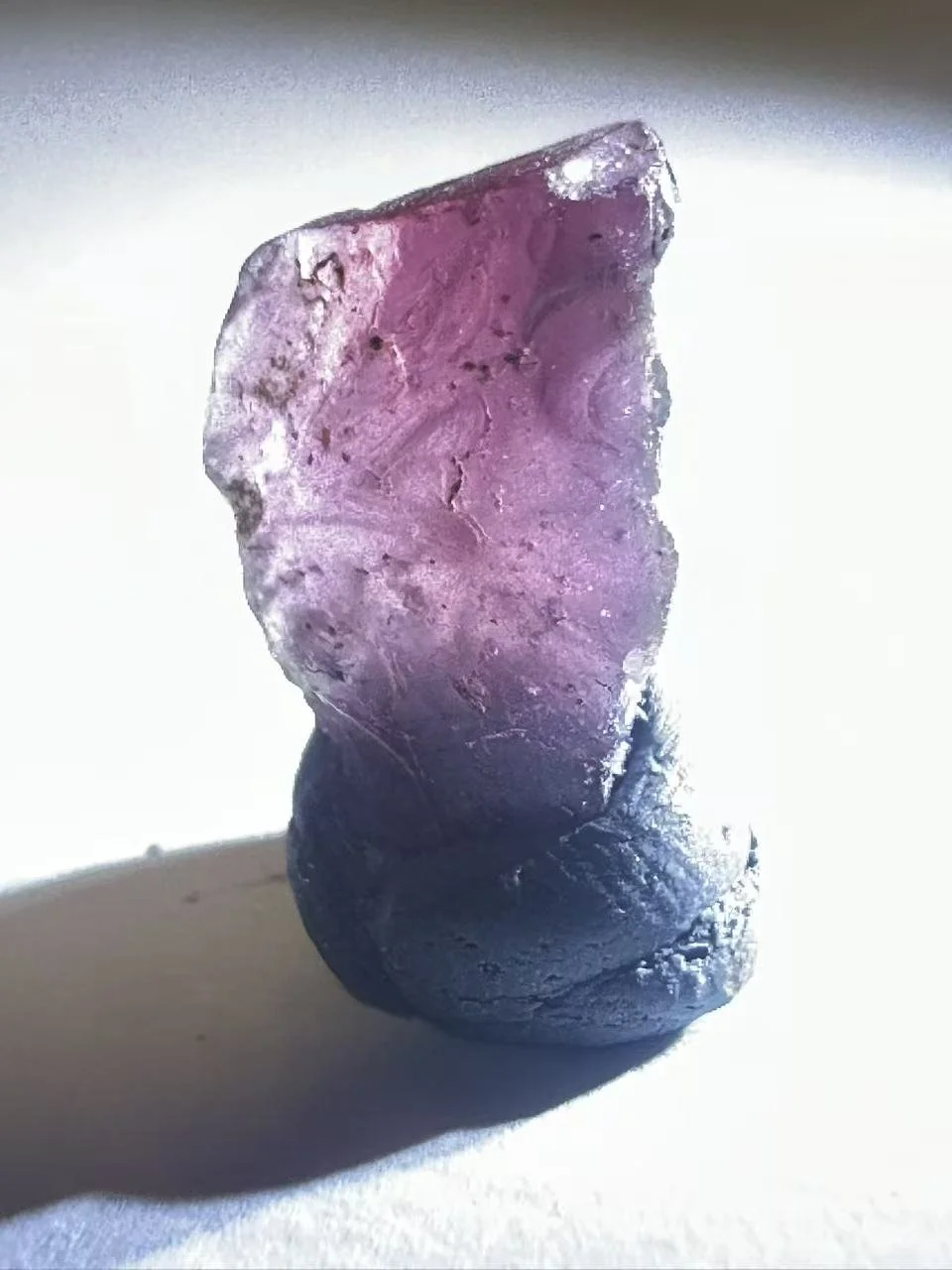
Garnet
Basic Properties of Garnet
Mineral Characteristics
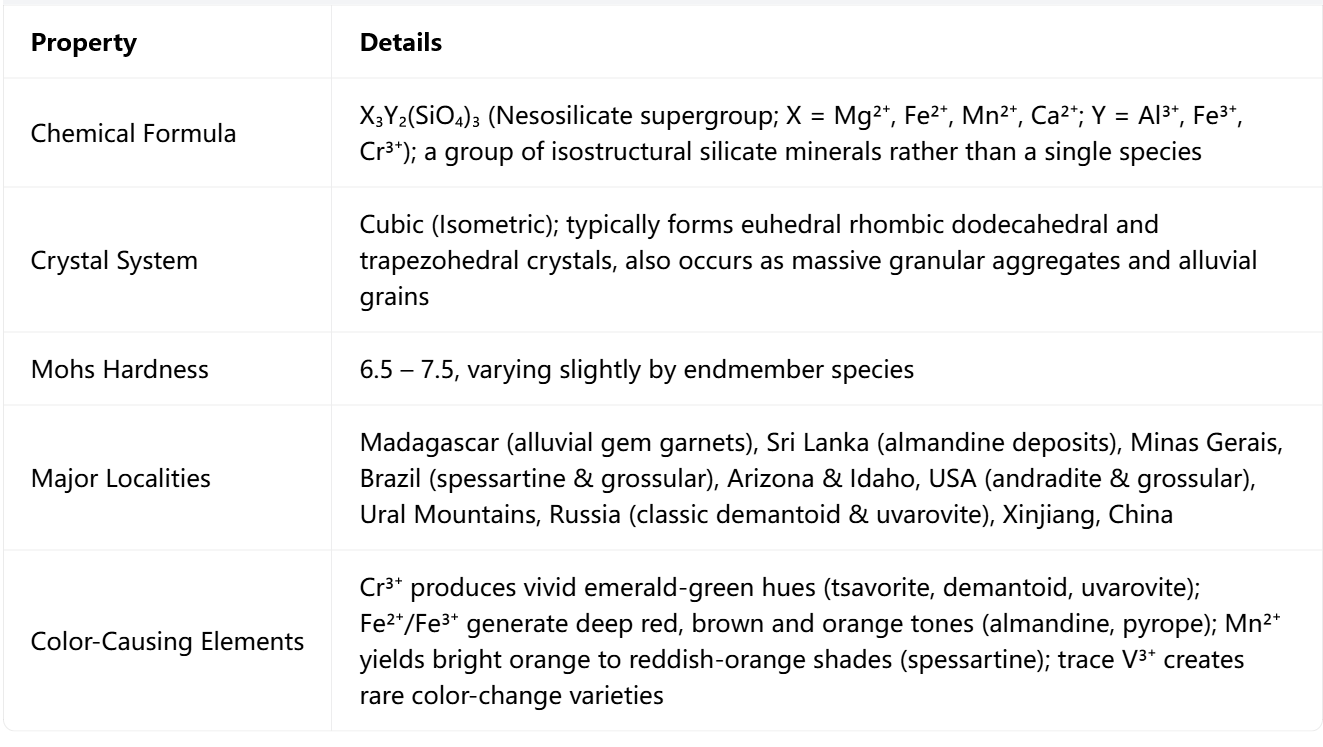
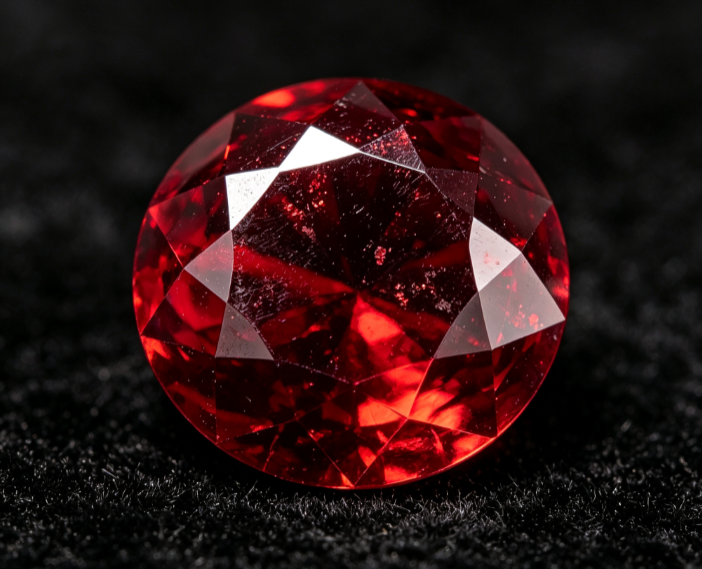
Garnet is not a single mineral species, but a structurally homologous supergroup of nesosilicate minerals unified by their cubic crystal structure and the general formula X₃Y₂(SiO₄)₃. The name derives from the Latin granatum, meaning “pomegranate”, a reference to the characteristic rounded, deep-red crystals that resemble seeds of the pomegranate fruit. All garnet species crystallize in the isometric system, most commonly developing euhedral rhombic dodecahedral and trapezohedral habits, often with combined crystal forms.
Extensive isomorphism occurs within the garnet group, with continuous solid solution between many endmember species. This compositional flexibility gives rise to the wide range of colors, physical properties and geological occurrences observed in nature. Gem- and industrial-grade garnets are divided into two principal chemical series: the pyralspite series (pyrope, almandine, spessartine, dominated by Mg, Fe, Mn on the X site) and the ugrandite series (uvarovite, grossular, andradite, dominated by Ca on the X site). Garnets form under a broad range of pressure and temperature conditions across metamorphic, igneous and sedimentary rocks. They are among the most important index minerals in metamorphic petrology: the compositional zoning of garnet crystals is used by geologists to reconstruct the pressure-temperature-time evolution of mountain belts and metamorphic terranes. Gem-quality material most frequently originates from skarns, pegmatites and kimberlites, and is often concentrated in secondary alluvial placer deposits.
Gemological & Industrial Applications
In the global gem and jewelry industry, garnet is one of the most diverse and widely available colored gemstones, and is the traditional birthstone for the month of January. It is fashioned into both faceted gems and polished cabochons, with clean, highly saturated specimens of rare varieties commanding premium prices. The most valuable gem garnets include demantoid andradite (vivid green with exceptional dispersion and characteristic horsetail inclusions), tsavorite grossular (intense emerald-green grossular), and high-grade color-change pyrope-almandine varieties. Common commercial varieties include rhodolite (rosy-pink pyrope-almandine solid solution), hessonite grossular (cinnamon-orange grossular), and deep red almandine, the most abundant gem garnet worldwide. With a Mohs hardness of 6.5–7.5 and excellent toughness, garnet is highly durable and suitable for all types of jewelry settings including daily-wear rings.
Industrially, garnet is one of the world’s most important high-performance abrasive minerals. Its high hardness, consistent fracture toughness and chemical inertness make it superior to silica and alumina abrasives for many precision applications. It is widely used in waterjet cutting for industrial manufacturing, abrasive blasting for surface preparation, grinding and polishing media for metals, glass and semiconductors, and as a functional filler in coated abrasives and sandpaper. Lower-grade garnet rock is also used as a high-refractory aggregate in furnace linings and high-temperature ceramics, as a filtration medium for water and industrial fluids, and as a heavy mineral aggregate in construction and geotechnical engineering.
Cultural Significance
Garnet is one of the oldest gemstones known to human civilization, with a history of use stretching back over 5,000 years. Ancient Egyptians buried garnet amulets with the dead as symbols of protection and eternal life, while ancient Greeks and Romans carved garnet into signet rings and decorative intaglios, associating the stone with faith, loyalty and safety in travel. Roman soldiers wore garnet talismans into battle, believing the stone would ward off injury and bring victory.
Throughout the Middle Ages, garnet remained a highly valued protective stone among knights and pilgrims, widely believed to light the way through darkness and guard against evil. In many traditional healing systems, red garnet was associated with blood, vitality and circulation, and was used as a remedy for inflammatory conditions and weakness.
In contemporary culture, garnet retains its official status as the January birthstone, symbolizing friendship, trust, constancy and passionate vitality. It is also the traditional gemstone for second wedding anniversaries. Within modern metaphysical and crystal healing traditions, garnet is regarded as a stone of grounding, regeneration and empowerment, believed to boost energy, enhance commitment and inspire courage. Across all eras and cultures, its enduring appeal stems from its deep warm color, exceptional durability and ancient association with protection and abundance.