Basic Properties of Jadeite
Mineral Characteristics
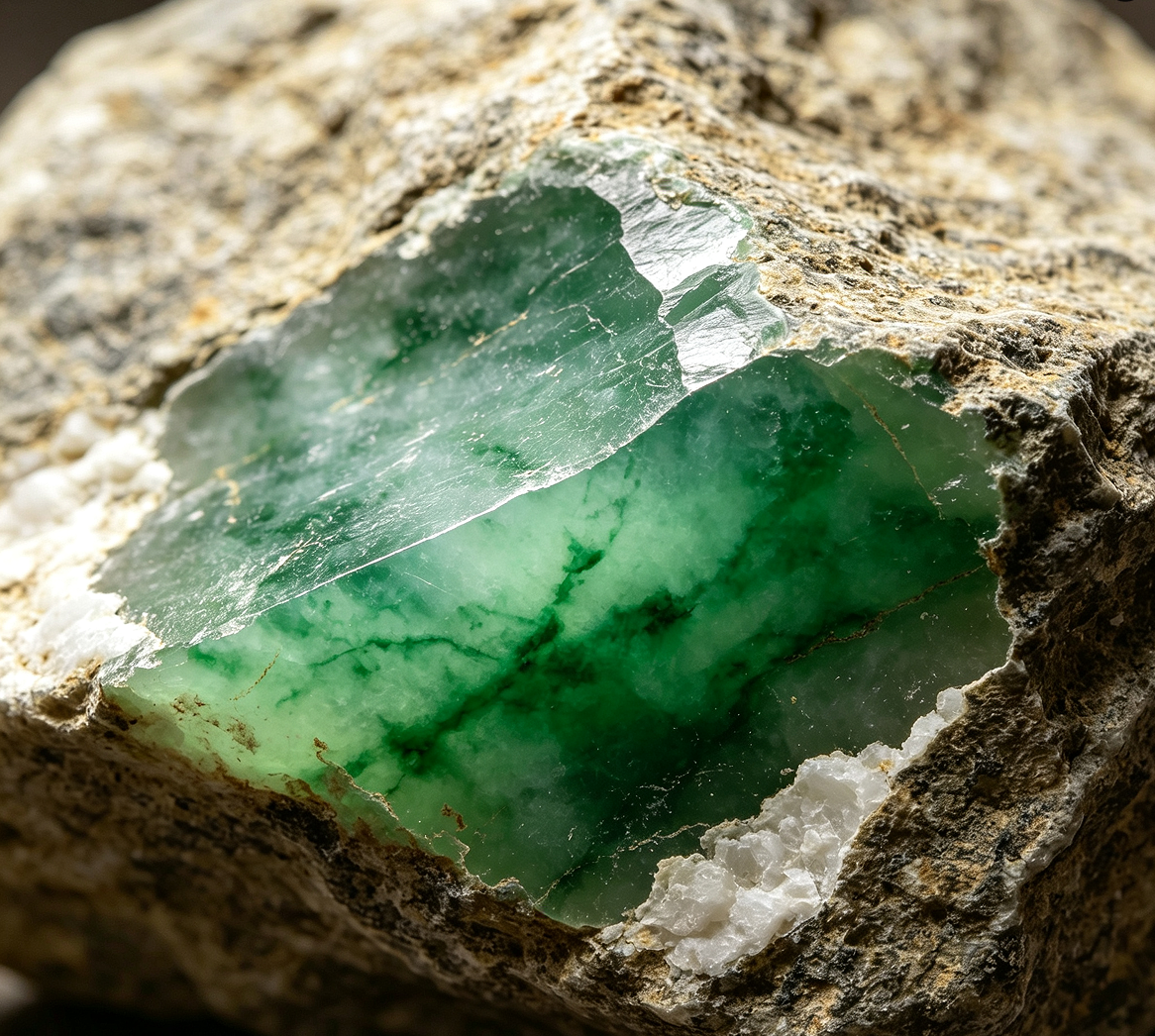
Jadeite is a rock-forming mineral in the clinopyroxene group. Gem-quality jadeite — the material known commercially as “jadeite jade” — is not a single crystal, but a dense, tightly interlocking aggregate of microscopic jadeite crystals. Unlike transparent faceted gemstones such as ruby or sapphire, fine jadeite is valued for its smooth, uniform texture, even translucency and saturated, consistent color.
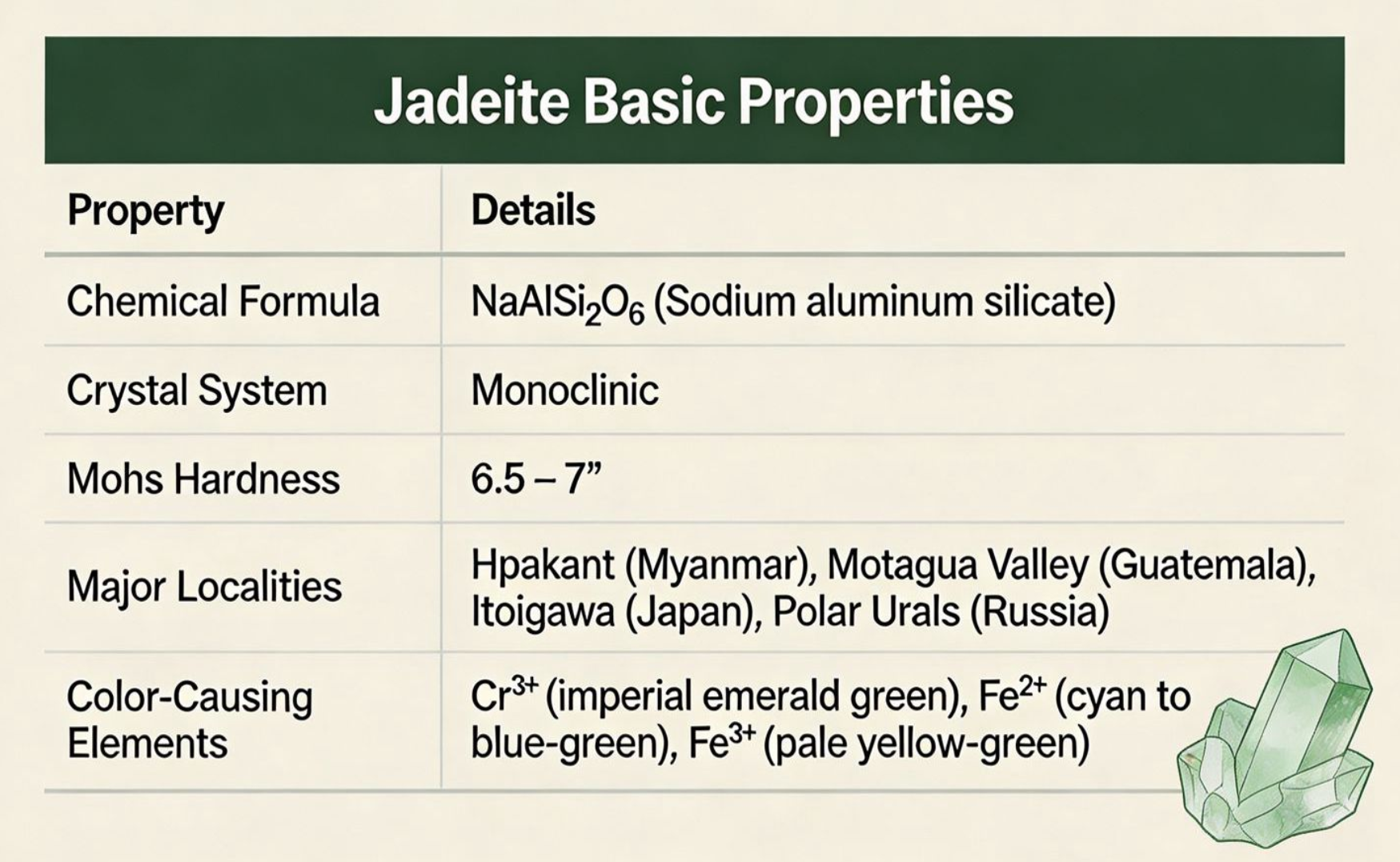
Its iconic green color is produced by isomorphous substitution: trivalent chromium ions (Cr³⁺) replace aluminum ions (Al³⁺) in the jadeite crystal lattice, forming stable color centers that create the highly sought-after “imperial green” hue. Iron acts as a secondary chromophore: Fe²⁺ gives rise to cool blue-green and cyan tones, while Fe³⁺ produces warmer yellowish-green shades.
Due to its intergrown granular structure, jadeite has exceptional toughness — greater than most crystalline gemstones — making it highly resistant to chipping and fracture. Fresh surfaces show a vitreous luster, which develops a soft, greasy sheen when polished.
Gemological & Industrial Uses
Gemological Applications
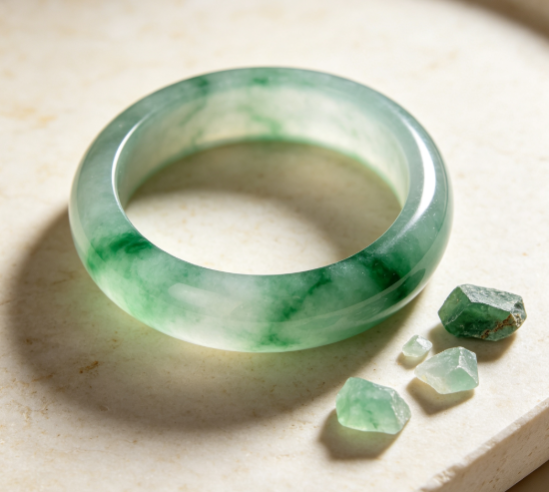
Gem-grade jadeite is one of the most valuable and culturally significant gem materials in the world. It is commonly fashioned into cabochons, round beads, solid bangles, pendants and elaborate hand carvings. Top-tier imperial green jadeite with high translucency can command extremely high prices on the global market, often exceeding the per-carat value of diamonds for exceptional specimens. In the gem trade, jadeite quality is evaluated by four key criteria: color saturation, degree of translucency, texture uniformity and craftsmanship.
Industrial Applications
Lower-grade jadeite rock and jadeite-bearing mine waste have specialized industrial uses. Because of its high hardness, chemical inertness and thermal stability, it is processed into wear-resistant machine components, precision instrument bearings and high-grade abrasive materials. Its dielectric properties also make it suitable for certain high-voltage insulating parts.
Cultural Significance
Chinese Culture
In China, jadeite has been esteemed for more than 2,000 years and is deeply linked to Confucian concepts of moral virtue. It traditionally symbolizes benevolence, wisdom, integrity and good fortune, and was worn by nobility and scholars as a visible marker of status and upright character. During the Qing Dynasty, imperial green jadeite became the most prestigious form of jade, reserved exclusively for the imperial court. Today, it remains a powerful symbol of luck, protection and intergenerational heritage in Chinese communities worldwide.
Mesoamerican Civilizations
Ancient Maya and Aztec societies mined jadeite in what is now Guatemala. They regarded it as a sacred stone of life, fertility and divine power, carving it into ritual masks, figurines and burial offerings. It was closely associated with sun deities and agricultural abundance.
Japanese Culture
Jadeite from Japan’s Itoigawa region has been used since the prehistoric Jōmon period, over 7,000 years ago. It was shaped into beads and protective amulets, believed to purify the spirit and grant long life. It remains an important material in traditional Japanese craft and spiritual culture.